Tues 10/15
I arrived in Lisbon late morning feeling surprisingly well
rested. The flight to Europe is too short to get a complete night’s sleep, but
through a combination of Benadryl, Portuguese red wine, and a new neck pillow,
I actually got a decent amount of sleep.
As an
aside, the traditional donut-shaped neck pillows don’t work for me. My neck is
too long and I have too much of a pinhead and so I get no support from them
whatsoever. I had read about the Trtl neck pillow,
which it turns out functions as something of a one-sided neck brace. If you
lean into it, it really supports your head. Pro tip: switch it from one
side to the other every so often, Also, Trtl, I’m saying good things about you
- sponsor my blog!
Anyway, prior to the trip I had picked up Rick Steve’s Lisbon
guide book. He provides a number of neighborhood walks, which is just how I
like to explore a new city – by just walking around. One of his walks passed
right by my hotel, so my thought for my first afternoon was to do that walk.
The hitch was that the weather forecast called for potentially heavy rain due
to the remnants of a hurricane passing by (!) – so my plan was to drop my bags
off at the hotel, then either do the walk, or if was raining, hit a museum.
But also, by total coincidence, a group of my BikeArlington
“Coffee Club” cycling friends were also in
Lisbon. These aren’t the people with whom I was doing my bike trip –
this is a totally different set of cycling friends. They texted me while I was
in the Uber from the airport (there’s Uber in Lisbon!) saying that they were
finishing up their day’s ride and were going to stop by a bar for a drink – by
karmic coincidence, about two blocks from my hotel. After dropping off my bags I
walked across Rossio Square, and there were Chris, Casey, Robyne, and Elaine.
It was super cool to join up with friends immediately upon my arrival in a
European capitol, so my afternoon’s touring plans went out the window and we
wound up hanging out and having drinks (outside, since it wasn’t raining after
all) and Portuguese appetizers including sardine and salmon spreads, crusty
bread, olives, and cheese. This group (plus three others who had already headed
home) had just finished two weeks touring Spain, and were in Spanish frame of
mind. From Chris, who is ½ Spanish, I learned a Spanish drinking toast:
¡Arriba! (meaning up – lift
your glass)
¡Abajo! (meaning down –
lower your glass)
¡Al centro! (meaning to the
center – put your glass out)
¡y pa' dentro! (meaning and
back in - drink)
We practiced that a few times, which is to say we had a few
drinks, then we all went out to lunch. The restaurant featured Portuguese
cuisine, which with stultifying regularity means a choice from among whole
grilled sardines, some sort of cod casserole, a couple of ham and beef dishes,
and a variety of unkosher sea creatures (tentacles of this and that …). Fortunately,
this place also offered Italian dishes. We ate inside (the forecast rain
finally arrived, with a vengeance). I had a pizza. European lunch can be a long
affair, particularly when the restaurant keeps comping you shots of port.
Finally, the rain let up and we parted ways. They headed up to their AirBnB; I
found my way back to my hotel, checked in, and stayed awake as best I could
(until about 9 PM) to start to get adjusted to European time.
 |
| Drinks with bicycle coffee club friends |
 |
| Sardine pate |
 |
| Lisbon hotel room was stylish, if small |
 |
| Pastry shop |
 |
| Ham shop - didn't go in |
 |
| Cannabis shop - didn't go in |
 |
| McDonald's - went in, but didn't order anything |
 |
| All the world over, people want Brooklyn coolness |
Weds 10/16
After a night of tossing and turning, I went downstairs at my
hotel to have breakfast. Breakfast was included in every day of the bike trip,
and in my jet-lagged state I forgot that I hadn’t opted to include breakfast
when I made my Lisbon hotel reservations. While I was still examining the
buffet the maître d' came over and
apologetically told me that I was not, in fact, entitled to breakfast. He
clearly felt bad about having to chase me away and comped me breakfast for the
day – and even offered me a discount on the other days. The thing is, the
reason I didn’t opt for breakfast is that I don’t eat big breakfasts –
certainly not 15 Euros worth of food. I took the comped breakfast, but for breakfast
on my other Lisbon days I just crossed the square and got a pastry and a café
Americano descafeinado (happily, decaf is pretty widely available in Portugal).
Let
me digress for a minute to mention the weirdness of Portuguese, which sounds to
me like drunk Russians pretending to speak Spanish. There are a lot of “zh” (as
in “Dr. Zhivago”) sounds and other odd consonants. In Spanish,
“descafeinado” could be reasonably pronounced by an English speaker just by
saying the word phonetically as written, but in Portuguese it sounds more like
“daizhgaffainado”. Portuguese also has a lot of cognates with Spanish, except
when it surprises you and doesn’t. For example, while you could say “por favor”
for “please” in either language, the two languages’ words for “thank you” are
completely different (“gracias” vs. “obrigado”).
The day’s forecast once again called for rain, but the day
turned out to be quite nice, if a little bit sticky. I started with the Rick
Steves self-guided walking tour I had planned for the day before, of the
downtown Baixa district – somewhat the equivalent of visiting the Mall in DC.
My hotel was located about mid-way through this walk, so I did the tour
starting in the middle, and I did plenty of deviations where places looked
interesting.
Big parts of Lisbon were flattened in an earthquake in 1755.
The Baixa dates primarily to the rebuilding after that disaster, so there’s an
actual street grid, as opposed to a Medieval warren of streets, with certain
exceptions– for example, the aforementioned Rossio Square is plopped in the
middle of the street grid and isn’t really a square. It is an oval, because it
started out as a racetrack in Roman times!
 |
| Typical street in the Baixa. Note the mosaic paving (common throughout Portugal) |
 |
Commerce Square
|
 |
| View of the Tagus River and the ocean beyond from Commerce Square |
 |
| All manner of canned sea creatures for sale |
I visited the historic Commerce Square alongside the river,
detoured to check out the cruise ship terminal area, and wandered into a
historic (since 1909) canned fish shop (high quality canned fish is something Portugal
is famous for). When the Spanish Inquisition started, Spain’s Jews were forced
to convert to Christianity, flee, or die. Quite a few who chose to flee made
their way to the seeming safety of Portugal but – surprise! – (Jewish history
is sadly full of such surprises), in 1506 the church whipped the populace up,
leading to an awful massacre of Lisbon’s Jews.
I visited the Sao Domingos church, where the disaster
started, an the monument outside to the Jews who were killed in this massacre. When
I got there an Israeli tour group was gathered around the monument. I smiled seeing
that that five hundred years later, and in the midst of yet another war started
by people who wanted to kill all the Jews, there were still plenty of Jews with
the opportunity and interest to play tourist and visit the place. The roof of
the church collapsed in the 1755 earthquake (some say if was punishment for the
1506 massacre), and there was a later catastrophic fire there. They’ve repaired
in such a way as to make it enclosed and fully functional, but have left the
damage visible – for example, the modern roof is colored in a way that makes it
obvious that it’s something added later.
 |
| Monument to the massacred Jews |
 |
Sao Domingo church
|
As recommended by Rick Steves, I stopped at a nearby ginjinha
bar for a shot of Portugal’s famous cherry liquor – a tourist trappy thing to
do, but only to the tune of about two bucks. From there I continued up Lisbon’s
equivalent of Fifth Avenue, a leafy boulevard lined with fancy shops such as
Prada, Rolex, and Hugo Boss. I grabbed lunch at a place similar to Sweetgreen,
but a little fancier. The lunch crowd there appeared to be mostly office
workers, but given the upscale neighborhood, the customers were actually the
most stylish-looking group of people I saw all week. And with that, I
considered the Rick Steves Baixa stroll completed 😀 |
| A glass of ginjinha |
About this time I heard from my travel companions Clare and
John, who had just arrived in Lisbon. They wanted me to share my location so
they could catch up with me and we could tour together; however, I was having a
good time rambling on my own and I realized, even if they didn’t, that they
were going to be exhausted from their overnight flight. So, I replied I’d meet
them later for dinner and continued my wandering with another Rick Steves
walking tour, this time of the Barrio Alto and Chiado neighborhoods. Portugal
sits at the crossroads of the Atlantic, the Mediterranean, and Africa, and has
long been a seafaring nation at the center of all manner of trade. The Barrio
Alto is a Medieval neighborhood traditionally home to sailors, and the Chiado,
while also quite ancient, is today a more hip neighborhood with shops and
nightlife – in Washington terms, I guess it’s Georgetown (this is a very, very
imprecise analogy).
Lisbon is a very hilly city. The Baixa lies down in a valley
near sea level, with other neighborhoods rising into the hills above it. To get
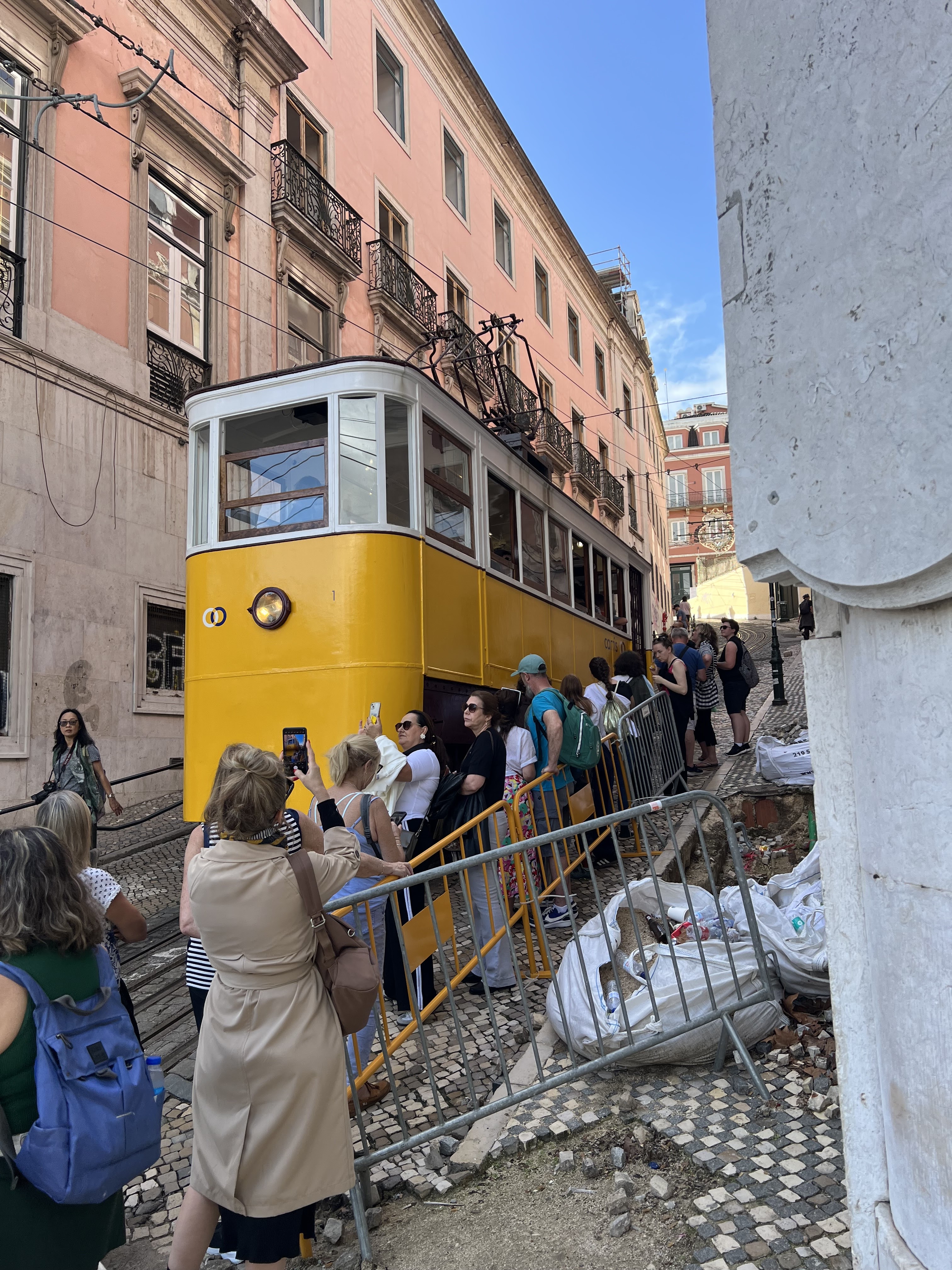
up to Barrio Alto/Chiado I decided to take the historic funicular. This is one
of those things like taking the streetcar in San Francisco. I doubled back to
the Rossio Metro station to buy a farecard (it took me a little while to figure
out the farecard machine!) and then used it to get on the funicular. In all
honesty, if you’re in reasonable shape you really don’t need the funicular to get
up the hill – I later climbed it twice on foot – but it’s a fun thing to do.
At the top of the funicular is a park with a view down over
the city (my week in this hilly country was to include lots of dramatic views
from on high). Also, it was the day before the Jewish holiday of Sukkot, when
Jews erect temporary hut-like structures called sukkahs where they eat and pray
(sometimes you see this holiday referred to, particularly by Old
Testament-loving Evangelicals, as the “Feast of Booths” or “Feast of
Tabernacles”), and in this park there were workers erecting what looked for all
the world like a big communal sukkah. Huh. Could there really be enough of an active
Jewish community in Lisbon to have a big public sukkah??
 |
| Boarding the funicular |
I next visited the Igreja de Aso Roque church. I’ve got to
admit, some of the majesty of Catholic churches is lost on me because I don’t
understand all the symbolism, but this one was fun because of its many
over-the-top rococo chapels. From there I went to the former convent known as
the Convento de Carmo, which now serves as a small archaeology museum. The
convent building is another victim of the 1755 earthquake. The main building
has been left roofless as a courtyard for the museum, while the collection is
housed in surviving rooms of the convent. The collection is a little
scattershot, but traces the incredibly long history of the area, including
artifacts dating back to the Chalcolithic era
(3,000-ish BC) through the Roman era to Medieval times. There are also some
oddball items, like a couple of Peruvian mummies. Interesting stuff, if you
like that sort of thing. I wandered through a small square filled with cafes
and street musicians, and poked into a music store, where they had accordion
books and a sign for accordion lessons, but alas no accordions to try. I played
one of the electronic keyboards a bit, then moved on. Yet another food Lisbon
is famous for are these little custard cup pastries called pastéis de nata.
Aside: Before my trip a friend, with the air of giving me a real insider
tip, let me in on the fact that I should try these little pastries, which he referred to as pastiche de Belém. Once I got there I
realized that pastéis de nata are everywhere - his insider tip was akin to
letting someone know that New York has this food called "pizza". Also, he had the name wrong. Nonetheless, the pastries are good, though I didn't get to try the ones from Pastéis de Belém bakery, which I gather is the DiFara's of pasteis.
Anyway, I took
a break and got a café Americano descaffeinato and some pastels, then strolled
Rua Garrett, a bustling shopping street in the Chiado with lots of shops,
street musicians (including one playing the traditional Portuguese song "I'll Be There for You", a.k.a. the theme from Friends), and cafes. By this point I was getting tired so I headed back
to the hotel, where I met up with into John and Clare. The three of us had a
drink, then I rested for a bit while they went out for a walk. I learned that
they’re extremely dedicated to getting their daily walk in, and even the
arrival of the forecast rain – which came down in buckets - didn’t dissuade them. After they returned and
dried off, the three of us went out (the rain had abated by then) to a nearby
restaurant which John had spotted while they were walking. It offered the typical
Portuguese menu of sardines, cod, ham, beef, and sea creatures – but
fortunately also salmon, which was quite tasty.
 |
| Convento de Carmo - or at least what's left of it |
 |
| Possibly a sukkah? |
 |
City view from Barrio Alto
|
 |
| Igreja de Aso Roque church |
 |
| Oh, baby! |
Thurs 10/17
 |
| You can see the castle on the hill behind me |
Since I wasn't likely to get another free breakfast at the hotel, I went across Figueria Square and got breakfast at a café - my usual Americano descafeinado coffee and an
almond croissant, after which it was on to the day's Rick Steves guidebook walk - this time up to the historic São
George castle and the Alfama, Lisbon's oldest neighborhood. Lisbon has various infrastructure to facilitate navigating its hills. I have already mentioned the funiculars; in this area, there are public elevators which take you up the hills. You walk into what looks like an office building lobby, but there's no building - it's just an elevator which takes you up to a plaza. Then you walk across the plaza and there's another elevator which takes you up towards the castle. There's a supermarket adjacent to the second elevator; I love to see what different foods are available in different places, and so I stopped in to look around. Not surprisingly, the supermarket offered lots of sea creatures for sale.
 |
| A variety of sea creatures (and Special K!) for sale at the market |
 |
| Bacalhau - traditional dried salt cod |
 |
| All kinds of tentacles |
 |
| Fresh fish counter |
Original bits of the São George castle date back to pre-Roman times, and over time it served as a fortification for the Phoenicians, Carthaginians, Romans, and Moors
before the forces of King Alfonso Henriques combined
with Crusaders laid siege to the castle and defeated the Moors, regaining
local control of land in the year 1147.
An aside: The story of Portugal is very similar to the story of Israel - a land at a crossroads, conquered by one foreign empire after another over the centuries (in Portugal's case the Visigoths from the north, followed by the Romans, followed by Islamic invaders from North Africa). Finally, the indigenous people overthrew the Islamic conquerors and reestablished their own country, ruled by the people whose land it had been since pre-history. They celebrate this history, and the heroic Alfonso Enriques, and yet, you see a fair number of pro-Palestinian signs around town. Go figure.
The castle is cool. First you enter the are within the old castle walls to find the old castle town, made up of Medieval buildings with noticeably short doors (people were short then!) packed tightly
together. This is where the upper crust lived - to be close to the king and the protection of the castle. It's really cute. You enter the castle itself via a bridge across a moat (of course). Castles are always built on high ground, and this one sits on a bluff
above the city with marvelous view. There's not much left except the stone structures, but a free audio tour tells you the history, and it's fun to climb the
ramparts and towers and walk through the courtyards, imaging the history.
 |
| Approaching the castle town |
 |
| View of Lisbon from the castle |
 |
| Castle selfie |
 |
| Convento de Carmo from the castle |
 |
| There's my hotel! |
 |
| Another city view |
 |
| Entering the castle |
 |
| Interesting view |
After exploring the castle I wandered the castle town some more then continued
down into the historic Alfama district. I ae lunch at Miss Can, a hip canned fish joint (if you can imagine such a thing) recommended in the guidebook. I basically had the world's hippest tuna fish sandwich - basically a plate of canned tuna, spicy olive oil, and fresh bread. I sat on church steps and heard successive tour
groups get the same shpiel abou ginjinha. I visited a nearby terrace which had its own lovely view, and a number of street musicians, including an accordionist who performed with a little dog on his shoulder.
 |
| Lunch at Miss Can |
 |
| Highlight of the trip |
 |
| View of the city, showing the cruise port |
 |
| Alfonso Enriques defeats and expels the Muslim Invaders |
 |
| Cool terrace plaza |
 |
| Yet another city view |
By accident, I came upon the Medieval Jewish
quarter. Two South African women were taking pictures below the "Rua da Judairia" sign. We chatted and walked around for a few blocks together, spotting (modern, it seems) Jewish influences, and even stumbling upon a sukkah (see above for what this is).
 |
| The Jewish Quarter |
 |
| Modern Jewish symbols |
 |
| At the sukkah with my new South African friend Beverly |
Back at the hotel, figured I'd crash for a while, but my room hadn't been made up, so I sat at hotel's outdoor café and had a beer (I had a free
coupon!). While I was sitting there John and Clare came by, in the midst of their own explorations. I tried again
to go upstairs, but room still not ready, so I decided to walk back up to
Chiado to check on the possible sukkah I had seen Wednesday. In a strange coincidence, I ran into the South
African women I had seen in the old Jewish Quarter. They mentioned an old synagogue nearby. I was pretty sure
it was something which wasn't open to the public, but I decided to walk over anyway (and check it out). This turned into 15 minute walk through
a really nice part of town. It wasn't as picturesque as Alfama, but was full of lively and
interesting shops, including a gelato stand where I got a small cup of stracciatella (a confusing name, since it also refers to a kind of cheese and a kind of soup, but for gelato it's sweet cream with chocolate shards). As I expected, the synagogue was locked up, with a police
guard - the reality of Judaism in Europe. I chatted with another couple (from Austin, TX( who were clearly there to take a look at the synagogue. Having walked quite far, I took the city bus back to my hotel. My room was finally ready, and I took a quick nap.
John and Clare, Mike and Terry, and I - the whole bike group - met up for dinner. We ate at another Nepali-run Portuguese/Italian place, The menu featured sardines, a cod concoction, beef, pork, and various sea creatures. I ordered pizza. It was good to finally meet Mike and Terry, with whom I'd be spending the week.
Later, I walked by myself back up towards the Chiado. I had seen a restaurant with a sign for
live fado (a traditional Portuguese music) in the evenings. I poked my head in but decided I didn't want to sit and listen to
Fado all night by myself. Fado is kind of like the blues - a local folk music that's cool to listen to, but to the uninitiated starts to sound all alike after a while. On the way back I came across a crowd of about 100 college-aged kids, mostly women, all dressed formally in black, and all wearing cloaks. They were in a circle in the Rossio square. Someone was in the middle leading them through something, and every once in a while they'd all chant in unison, but since it was all in Portuguese and I couldn't see to the center, I never figured out what was going on. It looked for all the world like a field trip from a Harry Potter-style wizard school (nerd note: given that it was Portugal, they likely would have been from Beauxbatons).
 |
| The castle at night |
 |
| Supermoon over Rossio Square |
Fri 10/18
Friday afternoon we were due to transfer to the town of Sesimbra to begin our trip, which left me the morning for sightseeing. After breakfast, I took a trolley to Belém - this is a part of town down by the river, sort of on the outskirts of Lisbon. There are a number of historic sights there, and it's the old port where Portuguese explorers would set out to sea. I waited in a long line to see Belem convent, which is
quite pretty but in truth there's not all that much there. Foolishly, I didn't realize there's a
separate entrance where you can go see the church, so I missed the tomb of
Vasco de Gama and a bunch more overwrought Catholic church stuff. This wasn't a biggie, because it allowed me to use more of my limited time to visit the
Maritime Museum. The guidebook gives the Maritime Museum a somewhat "meh" rating, saying it's the kind of place that's interesting if you like that kind of stuff, but I found it fascinating. Portugal was at the forefront of the age of discovery, and they were out exploring the oceans way before the other Europeans - perhaps you remember learning about Vasco de Gama, the first European to reach India by sea, or Prince Henry the Navigator, who sponsored voyages which discovered the Atlantic trade wind patterns (essential for sailing the Atlantic!), and sponsored exploration to Africa and beyond?
 |
| Belém Convent |
 |
| In the convent |
 |
| In the convent |
 |
| Joseph sold into slavery by his brothers (I recognize the Old Testament scenes!) |
 |
| Personal watercraft from India: 1450's |
 |
| Royal barge |
 |
| Tower of Belém |
 |
| Squeezed into the back of the Uber (that's Wellie, my travel companion) |
The museum has an excellent exhibit on the evolution of the Age of Discovery, including people,
ships, maps, how the knowledge of the world and trade expanded. There's also room after room of ship models, and a display of the actual royal
barges. After a quick lunch (spinach quiche) in the museum cafeteria, I walked over to see the Tower
of Belém, a UNESCO world heritage site, symbol of Portugal akin to the Eiffel Tower in France, and seaside landmark for departing and returning sailors during the Age of Discovery. Like the convent, it's an excellent example of Manueline style - an overwrought version of already overwrought Medieval architecture. Low on time, I didn't visit the interior of the tower, but I did walk a few blocks to find my first Portugal geocache, then hopped the trolley back to the hotel, a slow ride; I got back with little time to spare. The five
of us then piled into an Uber for the hour-long ride
to Sesimbra. Lisbon's version of UberXL (a van-sized car) turned out to be a BMW 2 Gran Tourer, a tiny wagon with a comically small third row (the Gran Tourer is only about an inch longer than Valerie's compact, two row Honda Civic sedan). The back seat was half folded down to hold our luggage. I took the other half, basically riding with the bags. Three people sat in the middle row, and one person in the front passenger seat. It was a full car!
That evening we received our pre-trip briefing from the outfitter, which took almost 2 1/2 hours, in part because my
Boomer fellow travelers either hadn't even loaded the app we'd be using for navigation or had a really hard time figuring out how to make
it work. John got upset because they couldn't accommodate his request for clipless pedals (the kind where you "clip in"). I had arranged for the pedals I wanted in advance - I'm no fool. Rafael the tour company guy was very patient with us.
We ate dinner at hotel, because by the time we finished our briefing around 9 PM no one was willing to walk the maybe 3 blocks
to a restaurant. The hotel restaurant's only offering was a rather sad, picked over €34 buffet, so we went to the bar
where, with some effort, I was able to order a "salad with grilled
haloumi cheese". I expected a dinner-sized salad topped with pieces of cheese, but it turned out to be like a caprese salad - just a stack of slices of tomato and big chunks of
halloumi cheese, all swimming in oil. Not even any bread or nothin'.
It was also there that I got the first realization that I might be traveling with some "ugly American" travelers when one of my fellow travelers wound up yelling at
bartender over something really minor. When you pay for something in Portugal with an American credit card, the machine asks if you want to pay in Euros or dollars. The difference in conversion rater on a €20 tab was going to be an amount measured in pennies, but somehow my travel companion freaked out that the bartender had chosen what she believed was the wrong conversion, and she wound up giving him a really hard time to make sure it was done the way she wanted. And as everyone knows, people will understand English better if you shout at them. Maybe she was just a little tired.
And thus began our bike trip ...
 |
| The beach at Sesimbra |
Continue to the
cycling part of the trip