Showing posts with label judaism. Show all posts

Wednesday, May 22, 2024

The Mississippi Delta Trip - Part III

Return to Part II

Day 6 (Wednesday - Greenwood and Oxford, MS):

I really haven't said much so far about the group I was traveling with. There were fifteen of us overall: the young assistant rabbi from our synagogue, Rabbi Stein, plus a woman from the temple staff who was the organizer of the trip, two couples, and nine individual travelers. All told, four men and eleven women. As I mentioned in Part I, I was the youngster of the congregants. There was one woman about my age, Professor Goldstein is I would guess in his 50's, and Rabbi Stein is in her thirties, but all the rest went up and up in age. However, just about everyone was game - not a lot of curmudgeonly old people behavior. And tech savvy, too - when it was suggested that we set up a WhatsApp group to communicate, only one person had trouble joining. I had taken a chance in rooming with Alex, who I had never met before the trip info session, but he turned out to be a lovely guy - a recent transplant from Massachusetts who moved to DC to be near his children/grandchild. He was a New England sports fan - every night he had the TV on so he could watch the Celtics, or the Bruins, or whatever. 
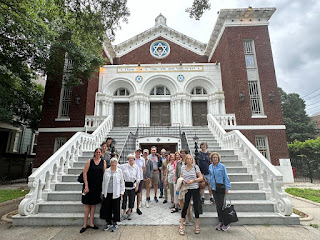
The generally grey-haired group 

Our first stop of the day was Congregation Ahavath Rayim in the small city Greenwood, MS. We had by this point seen thriving congregations, struggling congregations, and defunct congregations, but Ahavath Rayim was something else - a congregation which in practical terms no longer existed but which was being kept alive through the efforts of one of the few remaining Jewish families in town, the Goldbergs, who own a local string of shoe stores. Jewish Greenwood's story was one we had by then heard multiple times:  a once-thriving town shriveled over time due to the Great Migration of African Americans out of the Jim Crow south, automation of the cotton industry, the Great Depression, and more, and as the overall town shrank, so did its Jewish population. At its peak, out of 8,000 residents there were 300 Jews; now the number of Jews is down to a handful - mostly the extended Goldberg clan. Interestingly, Ahavath Rayim is categorized as an Orthodox synagogue since they use an Orthodox prayer book and rituals; however, it doesn't appear that any of the congregants live an Orthodox (traditionally religiously observant) lifestyle. Not that there really are any congregants. While technically Ahavath Rayim still exists as an active lay-led congregation, services are not regularly held there, and are limited to major holidays like Rosh Hashonah and Yom Kippur. Given the scarcity of synagogues in the area (there are four rabbis in the whole state), the holiday services are apparently well-attended, with attendees coming from all over the region. Earlier this year the synagogue even hosted a bar mitzvah (not surprisingly, of a member of the Goldberg family).

We heard all this history from Gail Goldberg, the current matriarch of the Goldberg family. It was fun just to hear her say Jewish words in her deep Mississippi accent. The Hebrew term for a congregation, "shul", which I pronounce such that it rhymes with "cool", takes on extra syllables in Mississippi. More like "shoooo-uhl". Interestingly, Gail said she had never felt any sense of discrimination of of being the "other". Her kids participated in church basketball programs, and they participated in all the town social events - some of which were church sponsored - they just went elsewhere to pray.

One website summarizes the situation in Greenwood as follows: "As of 2022 only a handful of Jews live in Greenwood and nearby towns, and most of them belong to the Goldberg family. Still, there are no plans to dissolve Ahavath Rayim, which will mark a century in its current synagogue in 2023." As long as there are Goldbergs, there'll be a synagogue in Greenwood. If a day comes when they can no longer maintain it, who knows.
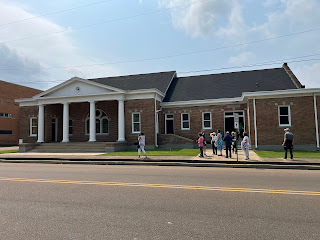

Temple Ahavath Rayim

While in town we stopped at the Jewish cemetery - small and not particularly noteworthy except that our professor/guide's great-great-uncle is buried there.

We had another lunch on the bus as we drove to Oxford, MS, home of Ole Miss (the University of Mississippi). There wasn't very much Jewish-related stuff to discuss there; even today, maybe 30 out of the school's16,000 identify as being Jewish. Instead, we were scheduled to hear about the "recontextualization" or Confederate artifacts (that means stuff like removing statues of Confederate heroes, and recognizing the contributions of enslaved people to the building of the school) at Ole Miss. We met with Andy Mullins, a former aide to the governor, co-founder of the Mississippi Teacher Corps (like Teach-for-America), and longtime university administrator. 

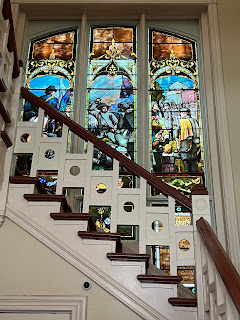
I wouldn't say he exactly delivered on the intended subject. He gave us a lot of history of the building we were meeting in, and laudatory statements about James Meredith, the first African-American student admitted to Ole Miss (he left out the part we learned later at a museum, that the university turned Meredith away four times - including having the governor himself show up to tell Meredith he wasn't welcome there - before letting him in). Mullins had that elliptical Southern way of story-telling, where every time you'd think he was about to get to the point he'd go off into some tangential folksy anecdote (Gail Goldberg had been like this too) and so he talked for a long time but never really quite got around to saying much about recontextualization, even when we went to see the spot where a big statue of Robert E. Lee had stood. He also noted that they hadn't removed everything related to the Confederacy; for example, the admin building is still graced by lovely stained glass windows honoring the "university greys" - Ole Miss students who fought for the Confederacy, and who he felt deserved to be honored for bravely fighting for a cause they believed in. 
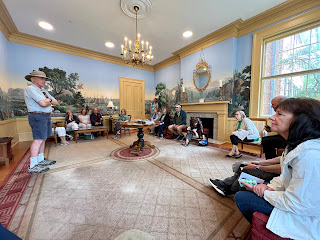
Dr. Mullins tells us more than we needed to know about the history of the building


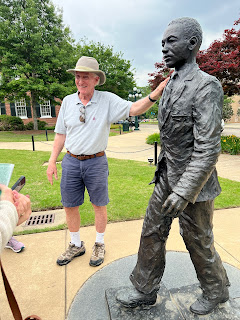
Andy Mullins with a statue of James Meredith

Honoring the "university greys"


Find the spelling mistake if you can!

We stayed overnight at a hotel right across from the campus, located on the historic square at Oxford - a cute college town. We browsed the historic Square Books bookstore and the other shops around the square. I had had an upset stomach for a couple of days, and so for dinner I went off on my own and found a place where I could get a plain grilled chicken sandwich. I had hoped to find some kind of crunchy granola vegetarian kind of restaurant where I could get something light to eat, but apparently things are different in Mississippi - while pretty much every college town I've ever visited has such a hippie tofu restaurant, such a thing doesn't exist at Ole Miss. The chicken sandwich was fine and I was recovered the next day.

Day 7 (Thursday - Memphis, TN):

On our last day we climbed on the bus for a drive to Memphis. Yes, I was spending my precious vacation time in Tennessee, of all places. Our first stop in Memphis was the National Civil Rights Museum, which is cleverly built to encompass the Lorraine Motel, where Rev. Dr. Martin Luther King, Jr. was assassinated. Where the Mississippi Civil Rights Museum had been more of a history museum, the National Museum told the story of a movement, to "share the culture and lessons from the American Civil Rights Movement and explore how this significant era continues to shape equality and freedom globally" - from the awful backstory of slavery and post-Reconstruction Jim Crow, through Brown vs. The Board of Education, the Montgomery bus boycott, student sit-ins, Freedom Riders, the March on Washington, Selma, Emmett Till, etc., through to the current day. One comes away with an appreciation of the courage and commitment it took to challenge, and ultimately change, American laws and culture.  

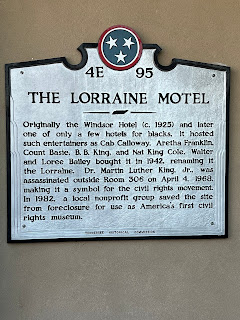
As an aside, I'll note that even without the MLK connection, the Lorraine Motel would itself have been noteworthy. A "Green Book" hotel, it hosted scores of African-American performers who came to record in Memphis.
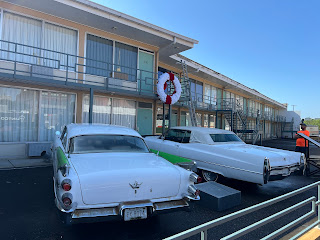
The Lorraine Motel - the wreath marks where Martin Luther King, Jr. was standing when he was shot


Read about the Lorraine Motel yourself

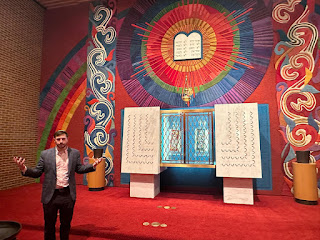
Our last stop was at Temple Israel. Now, we belong to the largest Jewish congregation in Virginia, located in one of the wealthiest counties in the U.S., and so we're used to large, affluent shoooo-uhls, but nothing prepared us for Temple Israel, practically a mega-church among synagogues. We entered an enormous building where our agenda started with lunch with the congregation's clergy, which consisted of tasty barbeque (chicken and beef - no pork) from a restaurant owned by a congregant, with plenty of fixin's - coleslaw, salad, and southern banana pudding (complete with vanilla wafers). By another coincidence, Temple Israel's senior rabbi had been a seminary classmate of our senior rabbi, and their junior rabbi was likewise a classmate of Rabbi Stein, so we had a connection from the get-go. Like Beth Israel in Jackson, Temple Israel has its own historic civil rights figure in the person of Rabbi James Wax. Wax's civil rights activism, as in Nussbaum's case, put him somewhat at odds with his congregation. When Martin Luther King was assassinated, Wax issued a rebuke of Memphis' mayor and, as the leader (and only Jewish clergy!) of the Memphis Ministers' Association, led the MMA's participation in the protest march that followed. Per Memphis magazine's web site, "The rabbi’s rebuke ... got national coverage. He got 81 letters of support, and 121 letters of condemnation. There were countless hostile phone calls and a loss of friends. Some members of the congregation talked of removing him from the pulpit, but the temple’s board of trustees refused to consider such an action — although other ministers who had participated in the march did lose their jobs."

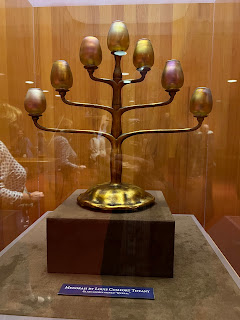
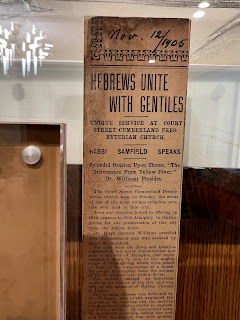
Oh, and I mentioned how enormous this place was. The building contains a gigantic main sanctuary, a more "intimate" chapel which seats several hundred (and is amazingly 70's groovy in design), a museum, a sizable Judaica shop, and seemingly endless grand gathering spaces, classrooms, and more. Plus, in contrast to the age and decay which seeped in around the edges of even the thriving congregations we had visited, Temple Israel was totally up-to-date and spotless. Nonetheless, they talked about how they were about to embark on a big renovation  of some the building's spaces. Apparently they benefit from being the only congregation in the region: west to Little Rock, south to Jackson, east to Nashville or Huntsville, and north to I don't know where - maybe St. Louis. Many congregants belong even though they're too far away to attend services regularly in person. They stream weekly services and attend in person only on holidays. Plus the synagogue benefits from being in the thriving city Memphis, a major transportation and shipping hub (FedEx is headquartered there) - and I would guess from some well-heeled donors. Their congregation isn't growing, but membership is close enough to steady that they feel like they can sustain things for a long time to come. We were left pretty breathless by the vitality and scale of this place.  
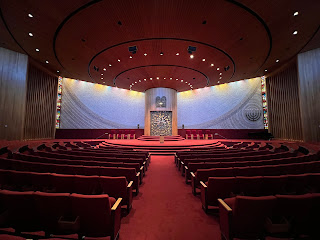
The main sanctuary at Temple Israel

Groovy chapel


Antique Tiffany menorah

From the museum

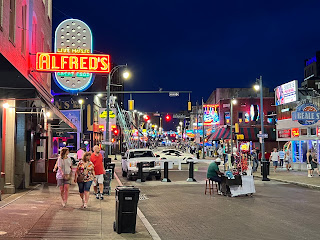
We had hoped to have a little free time in Memphis - to see the Stax Record Museum, or maybe visit Graceland, but alas, by the time we left Temple Israel, we didn't have much free time. We met up again for a farewell dinner, then we were Walking in Memphis, strolling down Beale Street, and poking our heads into the Peabody Hotel.
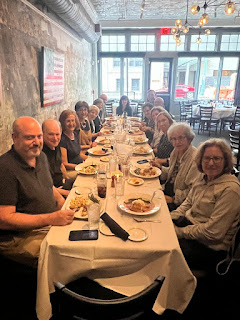
Farewell dinner

Beale Street

Friday morning another traveler and I who had reservations on the same early morning flight, caught a 5:30 AM Uber to the airport. And so ended our visit to the deep south, with a return home to the ... um, shallow south?


Sunday, April 28, 2024

Grateful Dead seder

What do the Grateful Dead and the Jewish ritual of a Passover seder have in common? Nothing. Except maybe that Dead shows and Passover seders seem to go on for a really long time. Also, maybe that they both feature leaders with big beards. And they both feature some kind of burning bush ... if you get my drift.

Anyway, Phil Lesh, the Dead's bass player, for a while owned a music venue in San Rafael, CA called called Terrapin Crossroads. In 2014 Ross James, a (Jewish) musician in Phil's orbit, asked Phil if they could host a Passover seder at his venue, and Phil not only concurred, he participated. The event was such a hit that they held it every year until the start of the pandemic. They even created their own Haggadah (the book is read at the seder, containing the Passover story and related explanations, along with prayers), which was surprisingly straight and unhippyish, except for the illustrations, commentary in the form of word bubbles from a little Grateful Dead terrapin dude (see the cover of the Terrapin Station album - the "terrapin" is a recurring Dead symbol), and the almost complete absence of mention of God.

The local Jewish community in DC has a disproportionate number of Jews (others have noted that this seems to be true as well throughout the Deadhead community). Many of my Jewish Deadhead friends seem much more connected to the band than to their religion (one friend having gone so far as to tell me that "The Grateful Dead is my religion"), and so I decided to create a Grateful Dead-themed Passover seder to help make this Jewish holiday more accessible to the Jewish Deadhead community. For two years I held the event at my house, which limited the number of people who I could invite. This year we went big and rented the Glen Echo community room - and got so many attendees that even with the larger capacity we wound up having to turn people away!

The gang

So, what was the seder like? I started with Lesh's Terrapin Haggadah, but trimmed it down a bit, including eliminating the whole part which would normally come after the meal (I was sure there was no way I was going to get the group to sit down for more ritual after they got to eating and schmoozing). I then sprinkled in a bunch of songs. A couple were seder text set to Grateful Dead songs, (for example, the Four Questions set to the tune of the song Ripple). Most were parody songs - clever (I hope) Passover-related lyrics for Dead and other classic rock songs. I drew on my friend Barb's Passover song parodies web site for "Hey Jews" (Hey Jude) and "Are You Ready for Passover Fare" (Scarborough Faire), grabbed Larry H's "It Must Have Been Charoses" (the Dead's It Must Have Been the Roses), plus a few of my own (like "Pharoah's Palace" for the Dead's Brokedown Palace). Valerie joined me up front, helping to keep order (she has that schoolteacher voice that people just obey) as well as adding her own brand of wackiness. Food was potluck and plentiful, and didn't even have to be kosher for Passover since the event was the night before the start of the holiday!

Leading the mayhem

I don't want to brag, but it drew comments like, "... the best seder I have ever experienced", "... so beautifully moving", and "What a special, meaningful, lively, loving, grateful, delicious seder!" So yeah, I think it was a success. We're already looking for a bigger room for next year.

And of course, I could not have made this event work without my fellow planners, Wendy (who wrangled all the attendee aspects including coordinating the pot luck), and Karen (who handled the logistics of the room, supplies, and decorating), as well as the volunteering of Woody, Jon, Carol, and so many more!

We had the ritual seder plate at every table

My Grateful Dead Haggadah

View from the "pulpit"


The organizers

Monday, January 15, 2018

Communities of Weirdos

I took up most of my outdoor activities for the simple enjoyment of doing them, and I still enjoy doing all of them solo; however, an unexpected benefit over the years has been that I've become part of communities of similarly obsessed people: kayak weirdos, bike weirdos, and so on. If drinking in a beer garden counts as an outdoor activity, then add my friends from Westover ;) I got to appreciate the community aspect of my activities several times this weekend.

Sunday morning was the first Lee District pool kayak rolling session of the year. When the kayakers show up at the pool in January we usually haven't seen each other in a while - group kayaking trips usually taper off after October, and right now the river is too frozen for any paddling at all (I suppose the Bay is still kayakable, but the launches may be iced in). So, the first pool session is something of a reunion of sorts with as time spent floating and catching up as rolling. This year was particularly poignant for me since it was the first time I tried any rolling since my surgery and there were lots of people cheering me on. A similar thing was true for Alison, who was back in the water after shoulder surgery. Of course, Alison's self-professed rustiness was a little different than mine - a past competitor in the Greenland kayaking championships, she was in the pool ticking off one roll variant after another (the Greenland championships include thirty-five different rolling-related moves) with balletic grace. I was thrilled to be able to do three kinds of rolls/braces (at peak I'm good for five - and only on one side).

Hey, I can still do this! (photo courtesy of Tall Tom)

The good news is that I had few problems with anything I did in the pool. My chest was mildly achy when I did chest sculls, but nothing that bothered me afterwards. My only significant concern is that on rolls where I went all the way around (+360 degrees as opposed to +180 followed by -180) I did experience a little lightheadedness (probably from the blood pressure meds I'm on these days). When I do a 360 degree roll I drive myself hard into the water to get upside down and around to the rolling setup position (a little more than the first 180 degrees) since I'm pretty light and have to overcome the buoyancy of the PFD. I hope that if I learn to slow that part down it might reduce the head rush effect I'm feeling.

It was cold enough that my kayak seat froze on the drive home

Monday morning I joined some cycling friends for breakfast at Lazy Mike's in Falls Church. While there's a cyclist breakfast meetup at Mike's every Monday, it being a holiday today's gathering served as a gathering point for a group ride. It was super cold (teens) and so several of us opted not to do the ride (35 miles or so) - but still showed up to socialize over breakfast. And so, a day after socializing with the kayak fanatics rolling in the swimming pool, I found myself having breakfast with 15 or so my favorite cyclist fanatics bundled up to the hilt for winter riding. Chemical hand-warmers. Multiple pairs of socks and gloves. Ski goggles. The other people in the restaurant probably thought, "why don't they just drive like normal people?" just as my neighbor said, "are you crazy?!" when she saw me loading my kayak in similarly cold temperatures yesterday (she assumed I was going paddling outside somewhere). Sorry, but doing crazy stuff is the nature of being part of a community of enthusiasts.

Boomer's selfie - getting ready to ride (I'm fourth from the left)

Chris' selfie during breakfast
As a coda to all of this I'll add that Saturday night we had about a dozen people over to our house for a pot luck dinner followed by what could be described as an elementary school style art session - coloring and painting. These are all friends from our synagogue (the coloring pictures were Jewish-themed), with whom we periodically do a pot-luck/activity dinner like this. Some might consider people from a "faith community" to be weirdos every bit as much as the people kayaking in a pool or biking in the freezing cold. I wouldn't necessarily disagree with them - is following Bronze Age commandments any less odd than trading suggestions on how to avoid "blue tip" (I will not explain what this is - suffice it to say it's a cold weather problem of concern to male cyclists)? The fact is, shared passions and beliefs lead to shared communities, and I'm grateful to be a member of several such communities.

Monday, October 3, 2016

Tashlikh by Kayak 2016

I have posted a number of times (going back to 2008!) about doing the Tashlikh ritual by kayak.

For readers unfamiliar with the practice, I present a quote from RitualWell on what Tashlikh is:

"Tashlikh, meaning "cast away," is a ritual performed on Rosh Hashanah (or during the 10 days between Rosh Hashanah and Yom Kippur) as a physical reminder of the human effort to cast away one's sins. By casting crumbs of bread into the water and reciting the verse from Micah—"cast all our sins into the ocean's depths"—we state our intention to return to our true selves. For many Jews, Rosh Hashanah is a time for reciting many words. Through tashlikh, we use our bodies and actions to do the work of return. Although the rabbinic authorities originally objected to this ritual, Jews stubbornly performed it until it became a "traditional" part of the holiday."

It's interesting at this point to look back at old entries describing past Tashlikh By Kayak outings:

  • In 2008 I still had my beloved Audi, and I can see in the background of the picture that accompanies the post that Don and Doris, my wonderful former across the street neighbors, were still there. Don and Doris were original owners - they bought the house new in 1952,  raised seven children there, and lived in that house the whole rest of their lives.
  • In 2009 I went with (then 16 year old) Ted.
  • In 2010 I didn't write much but I made a cool video.
  • In 2015 I went all the way down to Mason Neck and did quite a nice paddle.

 This year I went out the afternoon of Rosh Hashonah. I had already gone to religious services the evening before, and the whole family watched a live stream of services (you read that right) in the morning, so I was free in the afternoon.

I drove to Columbia Island Marina, which is undergoing a number of changes. They've automated payment for use of the boat ramp and I guess have gotten rid of the security guard, or at least they've taken out the guard booth. They'realso  re-doing the bathrooms. As has been noted in previous blog entries, the bathrooms at the marina have a well-known secondary use, and I'm happy/creeped out to report that someone has cut glory holes in the Porta-Potties which are currently standing in for the the bathrooms.

Anyway, that's a rather inappropriate tangent for a post about a religious practice, so let me return to the main topic here ...

For some reason I felt like paddling with my wing paddle, which I hadn't used all year. If a Greenland paddle is like riding a bicylce in a low gear, the wing is like being in a very high gear. Sometimes I can't make the thing work and I just struggle with it. Sometimes I get the flow of the stroke right and I can really fly with the thing. Today was the latter and I made really good time up the river to around Three Sisters Islands. It was somewhat windy so I pulled in towards shore and did the brief ritual. No rolling the crumbs off the deck this time - with Rosh Hashonah falling in October this year, the water was a little too cold.

Ready for the ritual

After I was done I booked back to the marina - again, a fast boogie with the wing paddle. This coming weekend a group from my synagogue is going to Roosevelt Island to do a Tashlikh ritual. I may just paddle over and join them!

Monday, September 14, 2015

Tashlich 2015

Here's a quote from RitualWell on what Tashlikh is:

"Tashlikh, meaning "cast away," is a ritual performed on Rosh Hashanah (or during the 10 days between Rosh Hashanah and Yom Kippur) as a physical reminder of the human effort to cast away one's sins. By casting crumbs of bread into the water and reciting the verse from Micah—"cast all our sins into the ocean's depths"—we state our intention to return to our true selves. For many Jews, Rosh Hashanah is a time for reciting many words. Through tashlikh, we use our bodies and actions to do the work of return. Although the rabbinic authorities originally objected to this ritual, Jews stubbornly performed it until it became a "traditional" part of the holiday."

Regular reader of this blog (hi Valerie!) will know that my personal ritual is to perform tashlikh by kayak. In years past I'd put little pieces of bread on the deck of the boat then roll. This year was a little chilly and breezy and so I opted to just toss crumbs from the boat. Unfortunately I left home in a hurry, forgetting to pack any bread crumbs, so I had to stop along the way and get something to use for the ritual. As a result, this year my sins were represented by 7-Eleven multi-grain snack crackers. Say what you will about my sins - they are whole grain and gluten free!

My Sins
While I was out I paddled a little bit up Kane's Creek, which was clogged with hydrilla, then over to Conrad Island where I checked on my Bye, Bye, Birding geocache. I finished a circumnavigation of Belmont Bay then headed in.

On Conrad Island
The turtle pond was quite active on this beautiful day, with lots of turtles and even a snake!

A snake in the turtle pond

Wednesday, December 19, 2012

Kayaking in Virzhiniya

Jews of my parents' generation were obsessed with knowing which celebrities were Jewish. In an era before people flaunted their ethnic roots and when anti-Semitism was a real concern, they relished a quiet pride in those Jews who had "made it" in the greater world (the actor Tony Curtis was born Bernard Schwartz!). My generation was clearly influenced by our parents' habit: Jewish celebrity name dropping is one of the main elements of Adam Sandler's execrable Hanukkah Song. I even have to admit I'm a little guilty of playing this game myself (Scarlett Johannson, Maggie Gyllenhaal, and of course Natalie Portman - if you are reading this you are welcome to come over and study Talmud any time. And bring Mila Kunis too).

Which brings me to Boris. I bumped into Boris when I was launching from Columbia Island Marina with a couple of friends on a cool December morning. Our goal was to paddle up to Fletcher's Cove Marina and rendezvous with a Meetup Group outing being organized by our friend Deke. Boris was there indepedently and launched behind us, but he did wind up catching up with us once we met up with Deke's group. Initially all I knew about Boris was that he was paddling a gorgeous work of art - a strip-built baidarka style kayak. Museum quality stuff, and not a kit like my Shearwater.

Deke's group was composed of a bunch of fairly inexperienced paddlers and some stand-up paddle boarders. We paddled up river together past Chain Bridge, but when Deke took the group up into the squirrely currents at the base of Little Falls I decided to hang back and have a snack. Taking that group into challenging currents in the cold waters of December seemed foolhardy to me and I just didn't want to be in the middle of it. For the record, the group did wind up with someone in the water -it was Deke himself who fell off his SUP; fortunately he self-rescued without incident.

Meeting up with Deke's group at Fletcher's
Boris came back downriver past me as I was enjoying the sunshine and my Powerbar. He hadn't really been with either Deke's group or mine to begin with and so wasn't waiting around for them. I myself had little patience for sitting around waiting for the group to return from around the bend and so the two of us decided to break off and return together to Columbia Island.

As we paddled back I learned that he was a Soviet Jew who had been part of the major Soviet Jewish emigration wave which took place in the 70's through 90's (just like Mila Kunis!). He had lived in Israel until eventually work took him to the U.S. - to Brooklyn, and finally Silver Spring, Maryland. As we paddled and talked he figured out that I was Jewish too. He was thrilled and amazed to discover another Jew on the water, and one who shared Brooklyn and Litvak roots at that (my mother's family, if you trace it a few hundred years, is from Boris' home city of Vilna). He excitedly exclaimed, in his Lithuanian/Russian accent, how unusual it was and how rare it was in all his years of kayaking to run into another Jew on the water (I have found this to be true as well).

Having basked in ethnic bonding all the way down the river we exchanged numbers, promising to kayak together again. It being the last day of Chanukah* we wished each other a chag sameach (happy holiday) and went on our ways - two modern day Noahs, each with our own little personal wooden arks.
Boris' & my kayaks
 *Chanukah is the transliteration I prefer for the Hebrew word ×—ֲ× ֻ×›ָּ×”. When referencing Adam Sandler's song I use the spelling he used in the title. Actually, I'm kind of keen on YIVO's choice of Khanike because of its Yiddish flavor and the clever use of the less common "kh" to indicate the "×—ֲ" sound.

Friday, September 10, 2010

Tashlich by Mayak

My Tashlich by kayak video can be see here.

L'Shanah Tovah!

On Hallowed Ground

Circumstances prevented me from attending services Rosh Hashonah morning. I usually like to spend some time outside on the holidays, as I find nature to be a spiritual experience. So, I brought my prayerbook with me and after taking care of my family business I made the quick trip over to Manassas Battlefield Park with the idea of finding a quiet spot to read through the morning rosh Hashonah service.

One cannot visit the Manassas battlefield and not feel the hallowed aspect of the ground. This was the site of two major Civil War battles (the battles of Bull Run, I was raised to call them, though in the South they're known as First and Second Manassas). Thousands died here in battles of brother against brother. The bible clearly understands this theme, containing as it does any number of stories of conflict between brothers. Had I done nothing other than walk the battlefield I feel like I still would have been learning biblical lessons, but I was intent on delving into the service. I walked the fields past the Henry House, the Stone House and up Matthew's Hill, finally finding and ducking into a stand of trees.

The morning Rosh Hashonah service opens with a biblical quote from Numbers. ""How beautiful are your tents, O Jacob, your dwelling places, O Israel! Like valleys they spread out, like gardens beside a river, like aloes planted by the LORD, like cedars beside the waters." I was immediately struck by the contrast between the photos I had seen in the visitor's center of the soldiers' tents and this biblical phrase. How would someone have reacted coming upon one of the encamped armies? Certainly not by declaring the beauty of the encampment.


The Rosh Hashonah liturgy is full of symbols of the specialness and fragility of life. To me, reading the passages on a battlefield brought home the specialness of our existence. One of the central prayers of the service, the Unetennah Tokef, reads in part 

""On Rosh Hashanah it is inscribed, and on Yom Kippur it is sealed: how many shall pass on, and how many shall be born; who shall live, and who shall die; who in his time, and who before his time; who by fire and who by water; who by sword and who by beast; who by hunger and who by thirst; who by storm and who by plague; who by choking and who by stoning... Who shall rest, and who shall wander; who shall be tranquil and who shall be harassed; who shall be at peace and who shall suffer; who shall become poor, and who shall become rich; who shall fall and who shall rise... But repentance, prayer and charity revoke the evil decree!"

Was G-d there at Manassas? Was he there as the floors of the Stone House were stained red with the blood of wounded soldiers, as artillery fire ravaged the troops? Was he deciding how many would pass on that day by sword? 

There is a majesty to going to a service, to hearing the prayers recited and chanted in a group environment. But there's something maybe even a little more special about studying them yourself in a place that is steeped in the theme of life and death.

Sunday, September 20, 2009

Tashlich by Kayak


The Jewish holiday of Rosh Hashonah is one of the major events in a season that focuses on repentance and introspection. At this time of year we ask for forgiveness for our sins and try to wipe the slate clean for the new year. One holiday ritual, dating back to at least the 15th century is that of Taslich, or "casting off". Taslich involves physically casting an item - typically some sort of bread - into a body of flowing water as a way of symbolically casting off sins. This ritual has its root in the following biblical passage:

G-d will have compassion on us,
and overcome our sins,
He will hurl all our sins
Into the depths of the sea.
(Micah 7:19)


I guess I shouldn't even have to mention the biblical connection. Judaism is a legalistic religion. Every word in the Torah is assumed to be there for a reason, and just about all of them are interpreted as some sort of commandment. Let me just say that if Genesis 2:2 read, "and on the seventh day, G-d had a cup of coffee then rested", then over the millennia Jews would have developed endless rituals and regulations about how to properly have a cup of coffee before the Sabbath: what is the minimum number of ounces required to be consumed? if one has a latte, which is mostly milk but is suffused with coffee flavor throughout, does that satisfy the commandment? Is the almighty telling us to drink decaf, as the cup of coffee is followed immediately by resting? Furthermore, Starbucks would have been started by a Jew ... oh, wait, it was. But I digress.

Anyway, being Reform Jews and therefore somewhat (well, quite) open to adapting traditions to suit our modern sensibilities, last year I created my own custom: taslich by kayak. Why cast away your sins from beside the water, I figured, when you could do it from on the water? After all, doesn't a kayak-based ritual get you closer to the "depths of the sea"? Last year was a success and so this year, after my turn on the beameh (pulpit) during morning services during which I had the honor of reading the blessings over the Haftorah portion, Teddy and I loaded up our boats and headed to Fletcher's boathouse, where we launched into the Potomac.

Teddy hadn't paddled in quite a while and so I wasn't sure how much paddling he was going to be able to do. On the one hand, he hadn't been in a kayak in about two years. On the other, he's grown into quite a strong young fellow. So I started out easy. We set out on a meandering trip down the river, pausing to sneak up on turtles and just float along - as well as to do our Taslich ceremony. I wasn't going to push him at all until at one point he said "what are we doing? I don't feel like I've gotten any exercise at all." That was my opening to step the paddle up a notch and so I suggested we head for Three Sisters Islands, a trip of a little under 2 miles from Fletcher's. We had the current with us and so made the trip pretty quickly.

Upon reaching Three Sisters we were greeted with an amazing sight. The river was so low that large swatches of dry land were peeking out of the water around the islands. It was like the parting of the Red Sea (oops, wrong Jewish Holiday reference). We later realized the water was shallow enough that one could walk among the three islands, which is not usually the case. Teddy beached his kayak on the first island and asked me to paddle alongside while he swam to the furthest island. Now, 70 degree water is a little cool for my taste for swimming, but perfect for Teddy, who is in many ways a penguin. He scrambled around the Southernmost island a bit and then I accompanied him back to his kayak. Now, while I may have referred to "dry land" above, in fact the exposed areas above water were really soft mud. Ted squooshed in up to his knees as he made his way back to his kayak, and with a flurry of mud we got under way.

As we started back I realized it had gotten late - and we were due at a friend's for dinner. We'd have to hurry if we wanted to make it back in time. I must say, Teddy came through! He paddled the two miles back at a very respectable speed with no breaks. Being unaccustomed to the upper body effort of kayaking, he was worn out by the time we got back to Fletcher's, but he did it! We squooshed through more mud at Fletcher's (the low river level exposed mud by the shoreline there too), tossed the boats back onto the car and headed home with Ted behind the wheel. We made it back quite a bit later than planned but were still only 15 minutes late for dinner. Not bad.

As for the ceremony itself, the ritual of Taslich is pretty minimal. There's no set liturgy. We used crackers to represent our sins - small objects to represent a perhaps large set of sins, but then again, think of how much data a memory stick can hold theses days. I recited the passage from Micah, put the crackers on my spray skirt and then put the kayak up on its side via a sculling brace. The crackers slid off and with them, symbolically, our sins for the year. If only it was so easy ...

Monday, August 31, 2009

Walking Meditation and Mellow Rock Gardening

On Saturday I led a meditation walk for a group from my temple. I have for some time been interested in the intersection between my love of the outdoors and my religious beliefs. I’ve also been involved with a Jewish meditation group, which in some cases draws upon kabbalistic tradition and in others outright appropriates or invents other ideas to create a Jewish meditation practice. I decided to combine all of these and do a Jewish walking meditation. Again, I didn’t invent this particular mash-up; I drew heavily on the writings of Rabbis Mike Comins, Jamie Korngold and Jeff Roth.

Nine people bet against the forecast of thunderstorms and showed up for the event (a winning bet, it turned out - the afternoon was unexpectedly sunny). After having a chance to ooh and ahh over a hickory horned devil caterpillar a ranger had just caught, our group off down a trail in River Bend Park alongside the Potomac to explore various meditative approaches – walking and stationary. I will not detail all what we did on our meditative shpatzir here. Rather, I’ll say that I was nervous about whether people were enjoying this (which was messing with my mindful awareness) until we got to a stopping point along the trail where we did some seated practices then shared a bit of how it was going. Listening and watching, I realized that not only were people into it, they were so into it that no one wanted to leave the beautiful spot we had chosen for our stop. The same thing happened when we sat down at some picnic tables at the end of our walk. After the silence of the walk, people were eager to talk and we wound up spending some time just lounging around by the river chatting. I certainly had no problem with this – lounging on and around rivers is one of my favorite activities.

Finally, people got on their way, leaving my friend David and to hit the river. While David and I had long known about each others interest in kayaking, we had never paddled together before. We put in at the boat ramp and headed upstream. Unfortunately you can’t get very far upriver before you start to run into riffles and rocks – not the ideal situation for a sea kayak. Still, we gamely explored various paths up the little rapids, ultimately successfully making our way further upstream. While the conditions on this section of the river are rocky, the views are awesome and further enhanced my enjoyment of the day. The meditation event had lasted longer than I expected (not that I'm complaining) and so I was somewhat time-limited on the water. So, after a little more exploration we turned around and let the current shoot us back downstream to the put-in.

As always, the drive along Georgetown Pike back to the Beltway was twisty fun. And I always wonder as I drive past the mega-houses that line the road – who is it who owns these multi-multi-million dollar things, who could possibly use so much square footage, at what size does a house just become irresponsibly large, …. and how can I get one?

Tuesday, September 30, 2008

Tashlich kayaking

It's not every day that G-d commands you to go kayaking. Well, by the most strict interpretations there's not any day when kayaking is a commandment. But every once in a while an opportunity comes along wherein you can twist the interpretation of religious practice such that it can involve kayaking. And that's why I love the Jewish holiday of Rosh Hashonah. One of the traditional customs of this holiday is Tashlich.

Tashlich is a ritual casting off of sins. In its most commonly practiced form people walk to a spot with flowing water, say a prayer, and symbolically throw their sins into the water to be carried away. The practice has its basis in an interpretation of Micah 7:18-20, which states, “He will cast off our sins into the depths of the seas.” While it's not 100% certain when observance of this custom started, the prophet Nehemiah mentions that on Rosh Hashonah “All the Jews gathered as one in the street that is in front of the gate of water.” Like many Jewish practices, there are many variations on the practice. For example, some Jews cast bits of bread on the water and watch them be carried away. Other groups say that the bread custom is completely forbidden, since (among other reasons) carrying the bread to the water is forbidden work on a holiday such as Rosh Hashonah. Such is the glory of a decentralized religion like Judaism.

Anyway, readers who stayed awake through the preceding paragraph may have noticed mention of a mitzvah involving proximity to flowing water. Note that performance of this mitzvah does not require that you stay on the bank of the water. In fact, what better way to feel the swirling push and pull of sins being cast off than to actually perform Tashlich out on the water?

At this morning's worship service I had the honor of being on the be'imah (pulpit) along with other board members and David, the temple president. As we waited for the service to begin I raised my idea with David. I had to admit I had a pretty good idea of what his opinion on the subject would be, seeing as how he had his Wilderness Systems Tsunami kayak already loaded onto the roof of his car. We conferred and agreed that a kayak is indeed a fine platform from which to perform the Tashlich ritual. Such is the glory of the Reform branch of Judaism. So, right after services I headed home, switched from tallit to Tevas, threw the boat on the car, and headed for Columbia Island Marina. Unfortunately, David wasn't going to be able to go out until later in the afternoon and so we couldn't observe this custom together.

It was mid-tide when I launched and so I knew the Boundary Channel would be impassible. I therefore headed out to the Potomac. As I headed upriver I was surprised to find a fairly strong wind at my back. With the help of this possibly divine wind I made it up to Roosevelt Island in no time at all. There, in the lee of the island I was able to pause and take out a few bits of bread and my printouts. I put the bread on the deck, read the traditional passages from Micah and Psalms 33, flipped the kayak over to release the bread into the water, then rolled back up. Despite the rabbinic suggestion in Pirke Avot to “Turn it and turn it again”, I did not do any more rolls – the water's starting to get kind of cold!

After completing the Tashlich ritual I continued upriver, figuring I'd stop by Jack's Boathouse to wish a L'Shanah Tovah (Happy New Year) to Paul, one of the proprietors. Unfortunately, there was no one down at the docks when I got there and so I continued on. About the time I left Jack's the wind picked up some more and it started getting darker. The weather forecast had included “Scattered Thunderstorms” and so I figured I should hightail it back to the put-in. I headed back down river, having fun banging through the slight chop on the way down. Fortunately the thunderstorm never arrived. In fact, by the time I got back to the marina it was sunny again.

I loaded the kayak back on the car, had a traditional Rosh Hashonah lunch of an energy bar and a Coke Zero at a picnic table by the water, then headed home with a purified spirit.


They call it "Toronno"

[Read about the first part of this trip here .] Americans know that Canadians talk funny. On the fifth day of our trip I started the day wit...