Sunday, September 29, 2013

Little Assawoman Bay

This weekend our wonderful friends Gail and Chris invited us to spend the weekend at their camper at Tall Pines, near Rehoboth Beach, DE. The camper experience was interesting in itself; the last time I had stayed in any sort of RV was probably almost thirty years ago when CJ's family had one. It's kind of like a cruise ship cabin in that you've got this cute, efficient but definitely tight living quarters. It's also kind of like camping in that once you step outside your "cabin" you're at a camp site, complete with fire pit, screen room, etc. It was a perfect fall weekend - no bugs, but still warm enough to comfortably hang out outside.

Great Minds Think Alike
Gail's life and mine have been intertwining for about a million years and the two couples have known each other for quite some time. As you can see from the composite photo of our cars at left, we obviously share some common thought processes. Overall, it was a great weekend not just "4 2" but "4 4".

On Saturday Valerie and Gail headed for the outlet malls while Chris and I headed for the water. I had brought my boat with me (conveniently already on the car from Thursday night paddling). We drove down to Coastal Kayaks in Fenwick where Chris was able to rent. Since he hadn't had wet exit training they wouldn't give him a full decked boat but at least they gave him a fairly decent rec boat, a 14 ft Pungo.

They warned us that it was a little bit choppy out and truth be told, once we were out of the cove where we launched I was surprised that they were even renting that day. The conditions weren't a problem for me but the wind was blowing out of the north at 15-20 MPH which, given the shallow water of Assawoman Bay, was kicking up some decent waves and even some whitecaps. Chris and I headed north into the wind, and stayed pretty close to shore as we worked out way up to the top of the bay. I was a little worried about an inexperienced paddler in a rec boat in those conditions but Chris is a good athlete and had no problems throughout the trip.

In the marsh


We headed through the narrows between Miller Neck and Fenwick Island then spent some time exploring some marshes where we saw abundant herons, egrets, and cormorants. Paddling through a marsh involves twisty exploration of little passages, some of which dead-end and some of which take you into new areas - and you're never quite sure where you'll wind up. In this case, when we finally popped out of the marsh back into the bay we were considerably further north than where we had gone in.

We had the wind behind us on the way back and so it was a quick ride. I've already mentioned that Chris is a good athlete, but I think it was wind assist that allowed him to maintain 5 MPH in a rec boat with relatively effort :) A little under 7 miles all told, pretty good for a windy day.

As I was loading my stuff into the car at the end of our trip I felt the twenty dollar bill I keep stashed in my PFD for emergencies fly out. By the time the event registered and I reacted the wind had picked the bill up and taken it away - I didn't see it anywhere. "Well," I thought, "I hope some lucky person finds it." However, a minute or so later one of the people from the shop (might have been Mitch Mitchell himself) walked over and handed me the twenty - he had seen where it had gone and recovered it for me. I suppose that at that point I should have spent it on some tchotchke from the shop, but I just thanked him and packed it back away in the PFD. And now I feel guilty ...

Our track

Sunday, September 1, 2013

Galesville Park Exploration

On Sunday of Labor Day weekend Tall Tom and I decided to recreate a trip which had recently been written up on the CPA site by Lisa A. & Tom B. We launched out of Galesville in search of the little accesses to parks Lisa and Tom B. had cataloged.


Our track


As I have mentioned in the past, Tom is a bigger guy than I am - let's just say that if the Chesapeake Paddler's Association ever put on a play based on Harry Potter, it's clear who between the two of us would be cast as Hagrid and who as Dobby - and he initially set a fast pace, but we soon settled into a good rhythm.

We headed northeast into the West River out of Galesville, rounded the corner and headed due east across the north side of Shady Side. When we reached Curtis Point (the northeast corner of the Shady Side peninsula) we turned due south. At this point we were out of the river and into the Chesapeake Bay. There was a little bit more of a breeze in the bay (welcome on a hot summer day) but conditions were benign - no significant waves.  We paddled a little further south than Lisa and Tom's track before turning around because we wanted to get a view of the bay around the peninsula.


Tom - Chesapeake Bay at Jack Creek


On the way out we had been taking direct paths everywhere; on the way home we took a more meandering path, exploring into coves and creeks. We first poked into a little creek to explore Jack Creek Park. Then we explored the whole of Parish Creek, pausing at a little beach to stretch our legs. We found the shoreline of Shady Side Park, though it turned out to be an unimpressive, overgrown little stretch of land in what was otherwise a cove of work boats and marinas.


In Parish Creek
 From there we largely retraced our path back. As always, as we paddled we drooled over the waterfront homes. One had a big "For Sale" sign on the end of its pier and there was a family out there looking at it (Tom could tell they were house-hunters from the fact that they were holding the brochure). "How much are they asking?", he yelled. "Eight hundred ninety-five thousand," was the answer. Less than I would have expected for a bay-front house with a deep water dock. I subsequently looked the house up on Zillow - it has a pool too, and a 3/4 acre lot - though the house itself is not huge. Also, it's Shady Side, not Annapolis.

With a dash across the busy boat channel we made it safely back to Galesville. After a quick stop for pizza and to browse the offerings at West Marine we were homeward bound. Total trip length 10.4 miles.

[For those interested, the locale of this trip can be found on p.8 of NOAA Booklet Chart 12263]


Saturday, August 31, 2013

Anacostia Morning Exploration


Sunday morning I had time for a kayak outing. I was looking for a change from my usual Columbia Island routine and so headed instead to Gravely Point, the next boat ramp down the Potomac. Gravely Point is distinguished by its location directly at the north end of the main runway of National Airport and so it's probably the loudest boat ramp in all of Virginia (unless maybe Oceana NAS has a ramp) . Gravely always has something of a party atmosphere, as it's always crowded with plane watchers, cyclists passing through on the Mt. Vernon trail, people who park there to enjoy the river views, picnickers, and boaters.


I launched at about 9 AM. As jets roared overhead I headed directly across the Potomac, catching some boat wakes as I crossed the boat channel, then headed around Haines Point and up into the Anacostia. The Anacostia River feels much more like a typical urban river than does the Potomac. Its banks are concrete and rip-rap and its shores are lined with working docks, marinas, and commercial buildings. It screams "city" much more than the park-lined Potomac.


The first major landmark on this route is Nationals Stadium. As always when I paddle past this point I think that it would be cool to come over some evening when they're having fireworks in conjunction with a Nats game - though that would mean a trip back across the Potomac in the dark. Next, up around Poplar Point is the Washington Navy yard, distinguished by the presence of the USS Barry, a decommissioned 1950's era destroyer. The Barry saw action in Vietnam and the Cuban Missile Crisis, but today's it's kept as a floating museum. Destroyers are mid-size ships as naval ships go, being less than half the length of a battleship or aircraft carrier, but from a kayak's perspective the Barry looks pretty darn big!


I like the marinas on the Anacostia. Unlike Columbia Island, which is filled with shiny new (but seemingly little used) boats, the collections at Anacostia marinas tend to be older, more slipshod and therefore more interesting. Old Chriscrafts, houseboats, and cruisers fill the docks, some listing, some obviously in need of repair, and some shipshape. One marina even had a handful of old wooden-hulled pleasure boats - a bitch to maintain, I'm sure, but very cool to look at.


I paddled as far as the railway bridge, which marks the boundary between the "ugly" Anacostia and the "pretty" Anacostia. Above this point you get into Kenilworth Aquatic Gardens then the National Arboretum. Unfortunately I was at the limit of how far I wanted to paddle for the day so after a break in the shade by the shore just past the bridge I headed for home. As I started for the railroad bridge - which is low enough that you have to duck under it a little - a train came by and so I stopped just short of the bridge and marveled at its bulk as it lumbered by. 


Every time I paddle the Anacostia I get yelled at. Last time some rowers from the Anacostia boathouse admonished a group of us for "going the wrong way" on the river and not observing "the rules". A post-trip web search revealed no such rules, save for those published by the boathouse, which carry something less than the force of law. This time I made sure to paddle in the direction the rowers expected (hugging the outside of the channel on the south/east bank on the way up, and the marina side on the way back). This time around I got yelled at by a group of fishermen who were lounging under a tree. My presence raised them from their torpor and they yelled that I was interfering with their lines and that I wasn't allowed this close to shore. "Read the Rules!" one guy yelled at me. Again, a web search revealed no rules, save for the regulations and procedures regarding opening the drawbridge section of the railroad bridge. My search did turn up a neat Anacostia Water Trail Guide (http://www.anacostiaws.org/images/maps/AnacostiaRiverWaterTrailGuide.pdf) which includes interesting historical facts: Captain John Smith explored this area in 1608, and it was a site of War of 1812 battles; the guide is, however, silent on "rules" of paddling the Anacostia.


My trip the rest of the way back was quick. The Potomac boat channel was busy and so I had to do a quick "frogger" crossing, then I made a bee-line back to Gravely Point. While I was loading my kayak a guy pulled up next to me on the ramp in a cool rowing wherry. I covet such a boat but they're much harder to pull in and out of the water than a kayak (they're bigger and heavier) and so I was curious to see how this guy transported his boat. He went and got his car - a mid-1970's Chevy Caprice station wagon. He backed the wagon down the ramp, put the back of the wherry on wheels, lifted the front into the wagon's rear gate then shoved it forward as far as it would go, securing it with a couple of thick rubber bungies. Those old wagons are pretty long and so it swallowed up quite a bit of the boat but even so there was at least eight feet sticking out the back of the thing when he drove off. I guess that arrangement works for short distances. I just hope he doesn't drive far that way.


All in all, a pleasant ten miles and another rule-breaking trip.


Monday, August 5, 2013

Western North Carolina, Part 2


Chapter 5: Asheville Cats
After a stop in the quaint town of Waynesboro for lunch (where we savored some non-gloppy food) we rolled into Asheville at about 2 PM to find ourselves in the middle of Bele Chere, Asheville’s wild, free street festival. In fact, this is rumored to be the last Bele Chere, ending a 35 year run and so it was bigger and higher energy than even its usual state. While the coincidence of our Asheville visit with the festival was a happy accident, it was something I had discovered in advance and so I had booked us a room at a lovely boutique hotel within walking distance of the festival. 
Air Dog Demo at Bele Chere

Bele Chere is in some ways wilder than anything in DC – western North Carolina just has more people who let their freak flag fly, as it were, than does buttoned down DC (have you ever seen women walking around topless at the Alexandria Scottish Christmas walk? I thought not) and the beer was flowing freely. On the other hand, it had a mellowness missing from big city festivals. Even on Saturday night the place was never too crowded, and the rowdiness was never out of control or threatening. Perhaps the most telling part, in terms of what North Carolina is about, was the ongoing (but completely non-violent) clash throughout the festival grounds between bible-thumpers who showed up megaphones in hand to denounce the sinners of Bele Chere and Asheville in general (libertines! Homosexuals!) and the large group of hippy-dippy counter-protestors shouting them down.

Religious Right Speaker & Counter-Protestors
Valerie and I spent Saturday night and Sunday wandering the festival, looking at the artists’ wares, browsing in stores along the way, people-watching and listening to bands on the festival’s six stages. I had never heard of any of the bands but they were all quite good, with styles ranging from bluegrass to electro jam band to funk to gypsy jazz.
We also explored Asheville’s restaurant scene, ducking into a Himalayan restaurant for dinner on Saturday when it started to rain, eating Southern-style breakfast Sunday at Over Easy (french toast with vanilla lavender yogurt and house-made granola for me with a side of grits – warning, the bananas were not locally sourced) and then dinner at Asheville’s famous Southerny/organic-y Tupulo Honey (trout with pepper aioli over grits for me - that's two grits meals in one day). Late Sunday afternoon I also managed to squeeze in a brief drive and hike on the Blue Ridge Parkway while Valerie napped.

Chapter 6: Build More
Did George W. Vanderbilt build enough living space in his house? No, he Biltmore! The Biltmore Estate was the attraction about which we got the most conflicting advice. Many of the folk at Folk School panned it as a touristy rip-off while others considered it an Asheville must-see. We decided that visiting Asheville without seeing The Biltmore Estate would be like visiting New York and not seeing the Empire State Building, which is itself both a touristy rip-off and a must-see.
We were glad we wound up deciding to visit. Being fans of Downton Abbey we viewed the whole thing through Downton eyes. Plus, the day we visited featured spectacular weather. We started by touring the gardens and wound up spending several hours strolling through Frederick Law Olmsted’s masterful landscape designs (the tour pamphlet for the Biltmore correctly credits Olmsted with designing New York’s Central Park and the grounds of the U.S. Capitol but shockingly omits mention of his true masterpiece – Brooklyn’s Prospect Park). We hadn't originally planned to spend so much time in the gardens, but once Valerie gets walking in the great outdoors it’s hard to stop her.
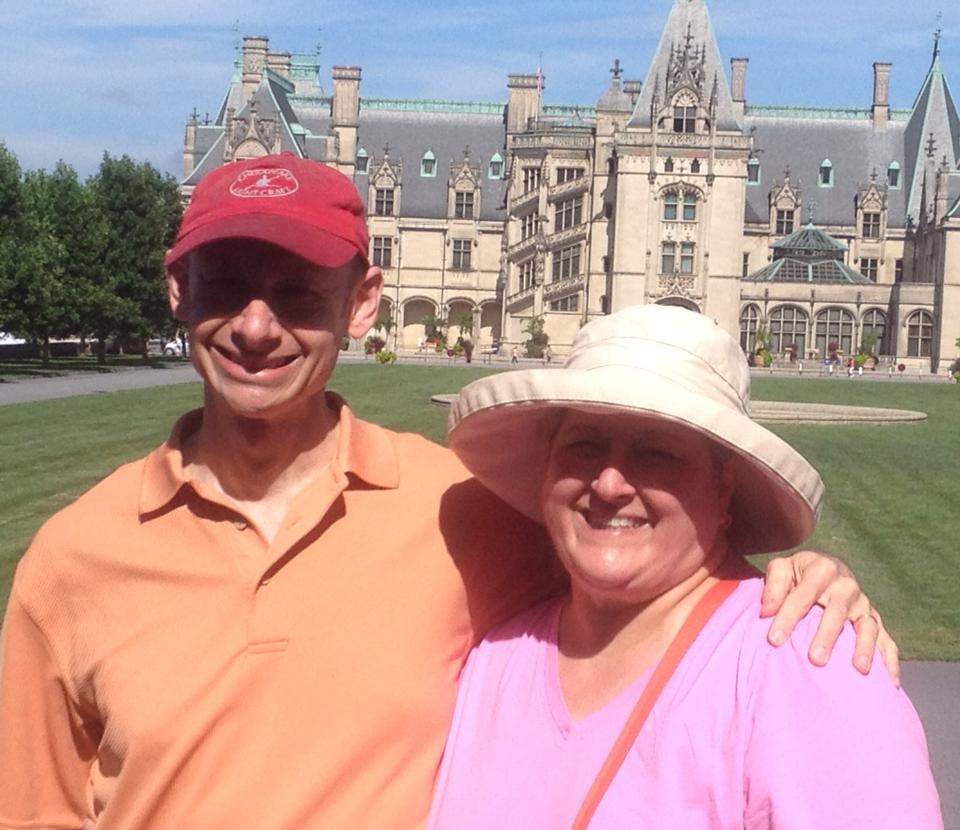
At The Biltmore Estate
We enjoyed the house tour as well. You only get to see a fraction of the house’s 255 rooms and 179,000 square feet, but the tour is well designed to show you key public rooms, family rooms, some of the 33 guest rooms, as well as “downstairs” kitchens, storerooms and servants quarters. We really enjoyed it. One funny moment: we were sitting out on a veranda enjoying the view of Mt. Pisgah when I overheard a conversation among a multi-generational family of visitors. The mom and dad were impressed but the grandfather, speaking with a discernible European accent, shrugged and said, “This is nice, but it doesn’t compare with what we have at home.” Sorry, buddy that we don’t have the Palace at Versailles (which is four times the size of The Biltmore!) here, but America's Castle Neuschwanstein has better rides than yours, and FastPass to boot.

During my visit I learned some things about George W. Vanderbilt: Like me, he was born in November ’62, had two older brothers and was a quiet, bookish sort. Also like me, his basement gym included a rowing machine (a fabulous 19th century steampunk looking thing – I wish photographs had been allowed!). The self-guided tour brochure noted that a man in his position would have dressed four to six times per day, depending upon activities – again, a man after my own heart (Valerie makes fun of me because I change clothes all the time for exercising, work, yard work, hanging out, etc.). Unfortunately there are a few differences between us, most significantly the huge fortune thing.

Speaking of the fortunes one lavishes on one’s children, on the way back from the Biltmore we stopped at the bank to see if we could take care of paying Ted’s August rent via a wire transfer. We were fortunate to be helped by a banker who grew up in Brooklyn and Long Island and with whom we had lots of other things in common. It was too close to closing time to get the wire transfer done but we did leave with a recommendation for a nearby pizza place, run by another Brooklyn expatriate.

Chapter 7: Book Homeward, Angel
Our last full day was a slow one. I got up and did some mountain biking while Valerie finished up our bank business and shopped. We met up for lunch then spent the afternoon lounging and reading. Real life began to seep in around the edges as we packed and I checked work email. Valerie's stomach had been bothering her a little bit and so on the last night we had a light dinner at a nearby crepe place then took one more stroll around downtown. We ran into Asheville's weekly mass hula hoop demonstration, another sign of the kookiness of the place.
Wednesday it was up and out the door early for the ride home. We arrived to find the house and cars largely unscathed, which was better than we had hoped for, and reunited with Ted & David over dinner.

Sunday, August 4, 2013

Western North Carolina, Part 1

Chapter 1: Southwestward, Ho!

Our journey into the Sow-uth begins with a nine hour drive from Arlington to Brasstown, North Carolina. We choose to break this trip up into two days and so we spend Saturday meandering down I-81, stopping in Lexington, Virginia for lunch. The spine of Virginia bristles with old towns which were thriving, if unremarkable, in the heyday of logging and railroads. Today they have maintained their unremarkability but with enough detectable quaintness to each merit an hour-long visit. David and I once spent a pleasant afternoon in Staunton during which we saw pretty much all the sights in town. On this trip Valerie and I stopped in Lexington, a town which is perhaps best known as the place where Stonewall Jackson served as an anonymous and eccentric college professor before achieving glory and immortality in the Civil War. Actually, Lexington boasts two colleges; however in late July it was, like most college towns, deserted. We ate lunch, browsed all three quaint shops, and drove on.


Actually, I am selling Lexington short. It is a prosperous and well kept little town which I’m sure is more lively during the school year. It exudes a kind of lost in time feeling that I really enjoy. Standing on Main Street I could see the historic buildings fade to grainy sepia and ghostly lounging Confederate soldiers appear on the steps and balconies. Plus we had some awesome hazelnut gelato after lunch.

Our next stop was Claytor Lake State Park where our plan was to camp for the night. Yes. Valerie. Tent camping. The weather had been pretty nice on the drive down but as soon as we entered the park the heavens opened up. I mean, the lord’s carwash kind of rain. We sat and read in the car at our campsite for about 90 minutes waiting for it to let up and were in the process of using our phones to search for nearby hotels when the almighty finally turned off the spigot. We worked quickly to pitch camp, figuring other showers might be headed our way. 

In the car, waiting for the rain to stop
We had gone kind of minimal on the camping, knowing that this was just one night of an eleven night trip. Rather than bring cooking gear to prepare food in camp we headed to nearby Pulaski, VA to find dinner. We drove the length of Pulaski – a process which involved moving the car forward maybe five feet – looking for a place to eat and were about to settle for Wendy’s when I spotted a sign for Fatz, a sit-down restaurant where we had a surprisingly good dinner. Well fed, we returned to camp and settled in for what turned out to be a rain-free night.


In the morning I broke out the one piece of cooking gear I had brought, a Jetboil stove, and prepared hot water for a gourmet breakfast of grits and Starbucks Via Brew instant coffee. When Valerie woke up we broke camp and got on our way. Our route dipped briefly into Tennessee where we stopped at a Welcome Station so Valerie could plant her feet on the soil and say she had visited the state. At the Welcome Station we also saw a poster for the National Banana Pudding Festival, which sounds like a spectacular event. Our route next took us around Asheville at which point we still had two hours to go. About this time we realized that with the same amount of travel time we could have gotten to Hawaii. But we would have missed learning about the National Banana Pudding Festival.

Chapter 2: Situation Normal, All Folked Up


We arrived at John C. Campbell Folk School and found it to be just the funky, artsy, friendly, mountainy place we had hoped it would be. The school works on a weekly cycle; everyone arrives the same day and the week starts with an orientation. When we walked into the orientation I was a little taken aback by the sea of grey hair. On first impression it looked like most of the attendees were there because they had aged out of Elderhostel trips. Valerie and I, having been born between the baby boom and Gen X generations are by now used to being the wrong age in every group we join and so weren’t really put off. Plus, looking around there seemed to be a few other attendees not old enough to have voted for Truman in ‘48 and so we shrugged it off.

After the first of many gloppy meals (more on this later) we headed to the pottery studio for an orientation. I had envisioned maybe a thirty minute intro, but in fact we dove right in to the first three hours of Pottery 101. Having spent the day on the road I was pretty tarred (or “tired”, as we Yankees say) but we went through the basics, made some tools and were throwing pots by the end of the night.


Our class, by the way, skewed younger than the attendees as a whole. I think the more strenuous crafts like pottery wheel tend to attract a younger crowd (and by younger I mean fifty-something). We were comfortably in the age range for what turned out to be a very nice group of people.


Chapter 3: Harried Potter and the Goblet of Failure


Every morning Folk School offers 30 minutes of pre-breakfast entertainment called “Morning Song”. Monday’s Morning Song featured the school’s director, Jan Davidson, giving the history of the school. Let me back up and say that about the time we hit Claytor Lake we had noticed that we had entered a region far more southern than where we live. Both Fatz and the Pulaksi Wal*Mart had been full of people who spoke like Foghorn Leghorn on Quaaludes [weird side note – Microsoft Word’s spell-checker is familiar with the word “Quaalude”, which might explain both Windows Phone and Windows 8] and the drawls only got thicker as we drove on southward. Sunday’s night’s orientation had been given by a woman who described herself as an “Appalachian Girl” and who expressed pride in her deep mountain twang. Jan Davidson is another native Appalachian. His Morning Song presentation included folksy history and some songs but was to Valerie and me largely unintelligible because we had forgotten to bring along our Star Trek Appalachian to Normal American English Universal Translator device. I enjoyed the songs and the three or four words I was able to comprehend.


After a gloppy breakfast we headed over to the studio for our first full day of class. There were eleven students led by our instructor Gail and her assistant Jackie. Gail is a fabulous potter who actually got her start thirteen years ago at a Folk School class. In addition to her pottery she runs a gallery in Georgia. Jackie is one of the artists represented by the gallery as well as a friend of Gail’s.
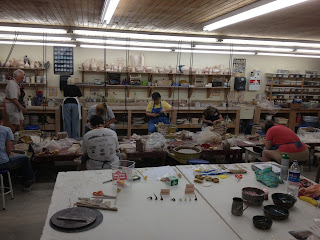


The pottery studio
I’ll cut to the chase and say that I was initially a total failure. I practiced two phase pottery throwing: first I’d throw the pot on the wheel and then I’d throw it in the trash. I also have to admit to some pretty poor behavior. While no pottery was actually smashed (I would have had to have successfully made some first) I got really frustrated and spend a couple of days in a pretty bad frame of mind. By the end of the first full day I had made some teeny cups and some larger mugs. Like everyone in the class, I was having trouble with “centering”, the process of getting a glob of clay centered on the wheel.

About the gloppy food: the food had been billed as a highlight of the place. Meals were said to be delicious and plentiful. As it turns out the usual chef was on vacation and to replace him or her they hired someone who appeared to have little cooking experience. Readers with back-country camping experience will understand what I mean when I refer to that meal you have on the last night of the trip, where you throw whatever is left into a single pot and cook it until it turns into some kind of mash which is tasty primarily because you’ve hiked all day and are prepared to eat just about anything. Well, lunch and dinner every day were quite reminiscent of a use-up-the-ingredients dinner, only with a lot more cheese. Main dishes appeared to have been stretched by using clay scraps and wood shavings from the studios as major ingredients. Vegetables supposedly fresh from the school’s garden were given the flavor and texture of canned. The food actually sickened Valerie. The only saving grace was that there was always a vegetarian option. Torturing plants has less gruesome results than torturing animals and so the veggie food was, to me, a little more palatable (plus it’s what I would have eaten anyway). Breakfast was navigable as well – while it featured an unrelenting parade of scrambled eggs, they also had hot cereal, dry cereal and fruit, which is all I need. Returnees to whom we spoke said that this was not typical Folk School food. Still, meals were a highlight every day since they were an opportunity to connect with people from other studios. People chatted about the work they were doing and how projects were coming along.


Monday night’s entertainment was the Whipstich Sallies, a quartet of young women from Indiana playing Bluegrass and Old-Time music. They were quite good – we really enjoyed their performance.


Tuesday we learned to throw our bowels. Actually, we learned to throw bowls, but with our instructors’ Georgia drawls the two sound pretty much the same. As the class built rapport with the instructors and each other the Southern accent thing became a running joke. Despite the Dixie locales on our name tags – Virginia, Florida, North Carolina, Georgia – it turned out that the students were primarily a group of Yankee carpetbaggers (plus additional obvious non-Southerners from Ohio and Mass). On day one we learned that the first step after centering is called “opening the well”, which I heard as “opening the whale”. I figured it was pottery slang (maybe a reference to a whale’s blow-hole?). It turned out that other people heard it that way too. The accent difference was such a big thing that our class exhibit on the final day included a Gail-Jackie Southern lexicon compiled by the class. There were other cultural exchange aspects as well. On our one non-scrambled egg breakfast day Jackie taught Valerie how to at biscuits and gravy. We asked Gail and if she had trouble understanding Northerners (answer: “We may talk funny but we don’t hear funny”), we learned a few good-old-boy phrases (e.g., “She pinches a nickel so tight she’s got the Indian riding the buffalo”), and we learned of Jackie’s disbelief that anyone could drink unsweet tea. Gail and Jackie were very gracious but I’m sure they spent the drive home shaking their heads over the Yankees they’d had to put up with.


Anyway, my bowl throwing was also pretty bad and by the end of Tuesday I was *really* frustrated and disgustingly pouty. Other people were taking their beginner-level skills more lightly – our classmate Laura was signing her pieces, “Laura, Age 5”. Fortunately Tuesday night’s entertainment was square and contra dancing. I don’t know nothin’ about such dancing but I went out and had a good time anyway, to the point where I tired Valerie out and wound up dancing with the other women from the class. 
Valerie at the Wheel


Gail picked up on my frustration (“We may talk funny but we aren’t slow”) and first thing Wednesday morning she worked with me one on one and walked me through throwing a bowl. That helped a great deal and from then on my success rate improved. I even got the basics down of making handles. Plus I was in a better mood from having started the day with a walk on the trails through the pretty campus.


Wednesday was also a race against the clock. Pottery is a multi-step process and so any piece we wanted to take home fully finished had to be completed by Weds so it could be bisque fired on Thursday, glazed Friday and then fired again Friday night into Saturday. A bunch of us skipped the evening entertainment and went back to the studio in the evening to work.


Chapter 4: Glazed Over


Thursday I started my day with an early morning run. They warned us again and again not to walk on the surprisingly busy Brasstown Road but I figured the side roads would be safe for a run. After grabbing a cup of coffee I headed out into the morning fog on what turned to be quite a hill climb, up past the Little Brasstown Baptist Church (which was anything but little). On the way back I ran through some parts of the campus I hadn’t yet seen. I got back in time to shower and head to Morning Song, which featured resident folklorist David Brose doing a schticky and entertaining set. We questioned him on his repeated use of the Yiddish word tuchas – turns out he had a Jewish grandmother. Which brings up the question: how goyish is western North Carolina? So goyish that this was the closest we came to encountering another Jewish person during our entire time in the state, even at the folky, craftsy, intellectual Folk School, an environment which would be catnip for Jews if located in, say, New England.


I built a few more pieces and trimmed some pieces which had dried. In the afternoon we learned the process we’d use on Friday for glazing, and Jackie gave us a demo on slab building, another technique of building clay pieces. Unfortunately the pace and the food glop had gotten to Valerie. After lunch she crawled into bed and stayed there until dinner. Thursday night we skipped the entertainment but did wind up hanging out on the back porch of the main building singing songs with our friend Elaine from class, her husband Louis (who was playing guitar), and Louis’ daughter, who worked at the school.
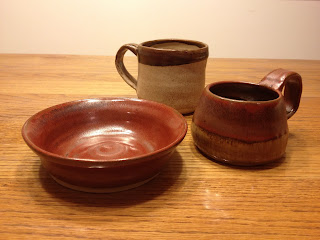

Examples of My Work
Friday was glazing day. Jackie and Gail went to the studio super early and pulled our bisque fired pieces out of the kiln. We went to work with a number of glazes. Some had obvious names (“Black”, “Turquoise”) while others had quirkier names like "Kim’s Orange Brown" and "McGruder Red". The bisque fired pieces still looked pretty rough, and coating them with glaze didn’t help much, as glazes don’t reveal their real appearance until the glazed pieces are fired. We spend the morning waxing, dipping the pieces in glaze, and dipping again (on this day we dipped more than once). Into the kiln the pieces went, marking the end of our potting for the week, The group spent Friday afternoon cleaning up the studio.


Friday afternoon was also the closing ceremony and class show. Unfortunately pottery had no finished work to show since everything was still in the kiln but we put together a display of the progression from lump of clay to finished piece plus an iPad slide show of Jackie’s photos from class. We also got to see the impressive work of the other classes: woodcarving, dulcimer building, blacksmithing, writing, calligraphy, doll making, weaving, broom making and kaleidoscopes while eating food cooked by the French cooking class.
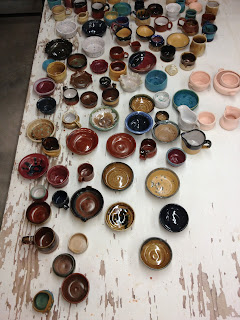
An array of finished work


Friday night’s entertainment was a performance by the dulcimer teachers. Unfortunately it started pouring just as we got back to our room after dinner and by the time it let up enough for me to venture out I had missed half the performance. I came back and we packed up our stuff.


Saturday morning I went running again. After breakfast the class converged on the studio, anxiously awaiting the results from the kiln like it was Christmas morning. In total ninety-six pieces of student work went into the kiln. There were a few losses – there always are, particularly with “fast firing” – but what came out astonished us. The pieces looked great and we all enjoyed seeing each other’s work. Alas, it was time to hit the road and so we carefully packed our pieces, said our goodbyes and headed out. We left with a cooler filled with our art and with new friendships with our classmates: Tom from the Northern Neck of Virginia, Pastor Mark from Chapel Hill (who never quite admitted to being clergy), Kristie from Fairfax, Sue from Florida (whose efforts to pay her son’s college apartment rent from the only vaguely Internet-connected Folk School paralleled our efforts to settle Ted’s rent), Professor Laura from Ohio (whose 6’ 8” husband was the easiest person to spot at every meal), Professor Peggy from Georgia, Danny the business consultant from Massachusetts, Jessica the art teacher who was brushing up on her clay skills, and the afore-mentioned Elaine from North Carolina. 
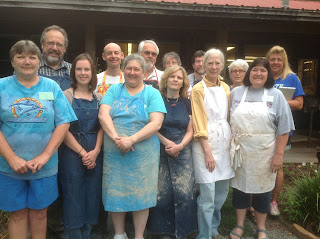
The Group, looking muddy. Gail is front left and Jackie is front right.
Oh, and I can’t forget other friends we made including John from Alexandria and Trish & Lynn, our wild and crazy next-door neighbors from New Jersey.


Sunday, July 14, 2013

Sunday Morning: Wing vs. Greenland

A bald eagle watches over Fletcher's Cove

Deer graze near Fletcher's Cove

Another Sunday morning paddle using the wing on the way up and the Greenland paddle on the way back. My trip was from Columbia Island to Fletcher's Cove, about 9 1/4 miles round trip. I wasn't running a GPS but from my timing and distance estimates on Google maps it appears I made about 4.9 MPH with the wing (upriver, but into the wind - both very small influences) and 4 MPH with the GP. That's a significant difference, enough to cut 10 minutes off of my upriver trip vs. my downriver trip. My speed on the return trip was has a little more uncertainty in it (it might be more like 4.1 MPH) as I stopped at one point to photograph some nature. I couldn't resist pulling out the camera - I had deer grazing to the left of me on the DC side and a bald eagle up in a tree on my right on the Virginia shore (excuse the crummy iPhone photos). You might say that even my pictures are "wing" vs. "green land" :)

A nice morning outing - on the water before 7, off before 10. That's whatcha gotta do to beat the heat in mid-summer in DC.

Saturday, July 13, 2013

First Time at Schaeffer Farm


The easy trails at Schaeffer Farm kicked my butt. There, I've said it. Back in April at SK102 Susanita clued me in to Schaeffer Farm Mountain Bike Park, a set of trails maintained by MORE (Mid-Atlantic Off-Road Enthusiasts) in a park near Germantown, Maryland. That's not far from where I work, so I've had it in the back of my mind to one day head to the MTB park for a spin before heading home. It only took me 2 1/2 months to put this plan into action, which isn't too bad in my book (actually I had brought my bike once before intending to do this but was foiled by a rainy evening).

After a later-than-expected departure from work, a couple of wrong turns and a quick change of clothes in the parking lot I was ready to ride. I'd read up on the trails - the white trail was the "easy" warm-up trail and was the one which connected with the parking lot and so I figured I'd start out riding the white loop then maybe move on to more challenging stuff.

"Easy" at the parks I've ridden before means fairly broad, flat trails; however, clearly the good folks at MORE are more manly mountain bikers than I am, because this trail quickly turned into twisty, hilly single-track, some of which was a little beyond my skills. For example, there was one point where you bomb downhill, cross a stream and then head straight into a steep up-hill. I slowed down to cross the stream which left me going too slowly to make it up the hill on the far bank.  So I stopped. I considered walking the bike up the hill, but no - I wanted to get this right. I walked the bike down to the base of the hill just past the edge of the stream and tried again, using the tiny bit of flat runway to get started. Well, I must have tried ten times. Sometimes I couldn't get my feet into the clips and get going quickly enough and I found myself on the hill before I even had my feet situated on the pedals. Other times I got part way up the hill but lost traction. Or I was in the wrong gear to push all the way up. Sad to say, I never got it; I finally gave up and walked. 

There were any number of other obstacles and terrain sections which proved too challenging. The good thing about mountain biking is that, unlike sea kayaking, you can always walk the tough parts. When you're in your kayak and you find yourself in four foot breaking waves you can't hop out, drag the kayak 20 feet to calmer water, then hop back in and resume paddling. With mountain biking you can always walk past that log obstacle or crazy jump. I skirted some steep drops into streams and a couple of logs. I fell once and would have fallen two more times had there not been trees alongside the trail against which I could steady myself. More times than I could count I wound up awkwardly grinding to a halt. It stinks being a newbie.

Also, as I had gotten a late start as I was riding the light started to fade a little - there was still plenty of daylight left but under the tree canopy it started to get a little dim. I'm great at manufacturing wilderness disaster scenarios in my mind and so I pictured losing my light and having to walk the bike back to the car in darkness with nothing but the single LED light on my keychain to guide me. This thought pushed me onward and I really kind of cranked as the trail opened up into a meadow towards the end. 

In the end I made it back to the car with plenty of daylight left, loaded my muddy bike (how is it that mountain bike trails are always muddy, even in dry weather?) and headed home. Actually, I headed to Thai Noi where I picked up some veggie pad thai for dinner. I must have been quite a sight, all muddy and scratched, and I'm sure they were happy when I paid for my food and got on my way.

Bike Refurbishment

Would you like to read a bunch of nerdy stuff about how I've been tinkering with my bicycles? Of course you would. I have two bicycles (...