Wednesday, June 19, 2024

Not quite according to plan

 I went to paddle at Mason Neck the other day not just because it's one of my favorite local places to paddle, but with several specific goals in mind:

1. Check on the geocache I had hidden on tiny Conrad Island, and do maintenance as necessary (e.g., replace the logbook).

2. Paddle at least 10 miles

3. Get some nice wildlife photos

Well, #1 had an unexpected outcome, I didn't achieve #2, and I kinda did OK with #3, but could have done better if things had gone according to plan.

While unloading my boat I chatted with a young guy in a Virginia State Parks polo shirt who was hanging around the launch. He told me that he was the kayak rental attendant, that the park had decided that it was too disruptive to haul someone over from the Visitor Center every time people wanted to rent kayaks and so had decided to hire someone to staff the kayak rental. My first thought was that the park must have better things it could spend its money on than this position - particularly staffing it on a weekday morning. It was Monday 9 AM and there wasn't exactly a big crowd of people waiting to check out kayaks. The second thing I thought was that weekday kayak attendant must be an intensely boring job, since there's essentially nothing to do.

After unloading my gear I moved my car to the parking lot, and by the time I got back to the launch area the attendant was gone. He also wasn't there when I paddled by later, nor was he there when I landed at the end of my outing. Maybe the park service hired him to work just Monday 9-10 AM. Or maybe I imagined him.

Anyway, my plan was to paddle across the bay to Conrad Island to check on the geocache, then head out around the bend into the river. Conrad Island is a wisp of an island situated on the opposite side of Belmont Bay, next to the boat channel which leads into the marinas along the Occoquan River. It's so small and low-lying that the boat wakes and waves have eroded it into multiple pieces, the biggest of which isn't more than a few hundred feet across. Back in 2008 I hid a geocache on the largest fragment of island, and people have generally like the adventure of boating across to the island to find the cache. However, as I approached this time I spotted something new: giant "No Trespassing" signs located all around the island. It's not clear to me who owns and manages the island, but clearly they don't want anyone to come there! Rather than update my geocache, when I got home I logged on and marked it as Archived (retired).

I think this means Keep Out

From there I headed southeast through Belmont Bay, heading for Occoquan Bay with the goal of heading out to the river. As I paddled it quickly became apparent that the wind was blowing much more strongly than had been forecast, maybe 15-20 MPH. The wind was whipping up the water too - nothing dangerous, but 1 to 1 1/2 foot waves, occasionally breaking, and sometimes rolling over the deck of my kayak. As I paddled I debated the wisdom of heading out into more open waters in these conditions, and when I got to the point where I could see out into Occoquan Bay, I decided that maybe going out there wasn't going to be a good idea. I mean, I could have handled the conditions but it wouldn't have been much fun, and you always have to think about what would happen if conditions deteriorated further. I turned around and decided to head up Kane's Creek instead. The creek is the most protected area around Mason Neck. It's popular with beginner paddlers (like folks who rent from the mystery kayak attendant) and is quite pretty. I had brought my nice camera with me, and was kind of disappointed that I wasn't going to get out to the river, which is where there's the greatest chance of seeing eagles, but I figured that even if I made it out there it was too rough for me to be able to pull out my camera and take photographs. Safety first.

A pretty spot on the water

As I headed towards the creek I took a quick break for water and a snack, and noticed that I was slowly drifting towards a blue heron. Herons are really skittish and it's hard to get close to them, but I figured that my drift rate might be slow enough that it wouldn't alarm the bird as I approached - and sure enough, I got close enough for some nice photos. Also, as I paddled eagles started swooping around like crazy - there were four or five hanging around together. Unfortunately, there was no way I was going to be able to grab my camera and catch them in flight. I had to "make do" with the joy of just seeing them.

Pretty good heron photo

I entered Kane's Creek and paddled a little ways up but quickly ran into hydrilla. Hydrilla is an invasive plant which chokes waterways, creating a dense mat of plant life under the surface so thick that you can't even get a paddle through it. Some years it doesn't seem to bloom at all, while other times it can make the areas where it grows impassible. I've never seen it so thick so early in the season before - but once I got to where I couldn't go on without crunching through the vegetation I turned around.

Showing the little birds some photo love too

While I was paddling back towards Mason Neck I saw some eagles again and detoured towards them to see if I could catch photos of any of them when they landed in the trees (eagles typically fly for a bit then hang out at the tops of the trees). I had a little bit of success in that I did get some pictures of two eagles in the trees, but nothing spectacular. I need a longer lens.

Eagle photo

Another eagle

When I got back to Mason Neck I discovered that I had only paddled 6.35 miles - well short of my ten mile goal. However, I had a varied, interesting experience and got the unexpected bonus of getting a little rough water practice in. The weather had been beautiful; it was a lovely morning out on the water.

Butterfly on the beach

Water scene from onshore

-----
Addendum: another reason I'm sad to see my geocache go is that I loved the name I had given it. The cache was on Conrad Island, which is home to lots of birds. It's a great place for birding, so I named the geocache "Bye Bye Birding", which is a play on "Bye Bye Birdie", a 1960 musical the main character of which is named Conrad Birdie. Get it? Conrad Birdie, Conrad Island full of birds? "Bye Bye", because the island is disappearing? Birdie vs. birding? Dear reader, if you are not currently overwhelmed with laughter from the cleverness of my geocache name you should see a doctor about your atrophied sense of humor. 

Wednesday, May 22, 2024

The Mississippi Delta Trip - Part III

Return to Part II

Day 6 (Wednesday - Greenwood and Oxford, MS):

I really haven't said much so far about the group I was traveling with. There were fifteen of us overall: the young assistant rabbi from our synagogue, Rabbi Stein, plus a woman from the temple staff who was the organizer of the trip, two couples, and nine individual travelers. All told, four men and eleven women. As I mentioned in Part I, I was the youngster of the congregants. There was one woman about my age, Professor Goldstein is I would guess in his 50's, and Rabbi Stein is in her thirties, but all the rest went up and up in age. However, just about everyone was game - not a lot of curmudgeonly old people behavior. And tech savvy, too - when it was suggested that we set up a WhatsApp group to communicate, only one person had trouble joining. I had taken a chance in rooming with Alex, who I had never met before the trip info session, but he turned out to be a lovely guy - a recent transplant from Massachusetts who moved to DC to be near his children/grandchild. He was a New England sports fan - every night he had the TV on so he could watch the Celtics, or the Bruins, or whatever. 
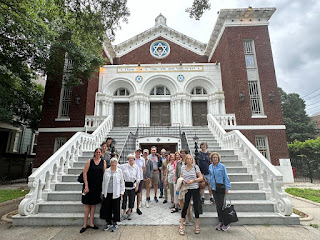
The generally grey-haired group 

Our first stop of the day was Congregation Ahavath Rayim in the small city Greenwood, MS. We had by this point seen thriving congregations, struggling congregations, and defunct congregations, but Ahavath Rayim was something else - a congregation which in practical terms no longer existed but which was being kept alive through the efforts of one of the few remaining Jewish families in town, the Goldbergs, who own a local string of shoe stores. Jewish Greenwood's story was one we had by then heard multiple times:  a once-thriving town shriveled over time due to the Great Migration of African Americans out of the Jim Crow south, automation of the cotton industry, the Great Depression, and more, and as the overall town shrank, so did its Jewish population. At its peak, out of 8,000 residents there were 300 Jews; now the number of Jews is down to a handful - mostly the extended Goldberg clan. Interestingly, Ahavath Rayim is categorized as an Orthodox synagogue since they use an Orthodox prayer book and rituals; however, it doesn't appear that any of the congregants live an Orthodox (traditionally religiously observant) lifestyle. Not that there really are any congregants. While technically Ahavath Rayim still exists as an active lay-led congregation, services are not regularly held there, and are limited to major holidays like Rosh Hashonah and Yom Kippur. Given the scarcity of synagogues in the area (there are four rabbis in the whole state), the holiday services are apparently well-attended, with attendees coming from all over the region. Earlier this year the synagogue even hosted a bar mitzvah (not surprisingly, of a member of the Goldberg family).

We heard all this history from Gail Goldberg, the current matriarch of the Goldberg family. It was fun just to hear her say Jewish words in her deep Mississippi accent. The Hebrew term for a congregation, "shul", which I pronounce such that it rhymes with "cool", takes on extra syllables in Mississippi. More like "shoooo-uhl". Interestingly, Gail said she had never felt any sense of discrimination of of being the "other". Her kids participated in church basketball programs, and they participated in all the town social events - some of which were church sponsored - they just went elsewhere to pray.

One website summarizes the situation in Greenwood as follows: "As of 2022 only a handful of Jews live in Greenwood and nearby towns, and most of them belong to the Goldberg family. Still, there are no plans to dissolve Ahavath Rayim, which will mark a century in its current synagogue in 2023." As long as there are Goldbergs, there'll be a synagogue in Greenwood. If a day comes when they can no longer maintain it, who knows.
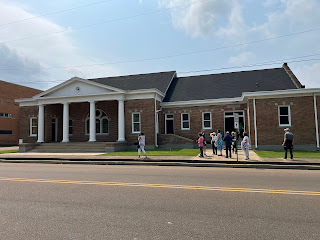

Temple Ahavath Rayim

While in town we stopped at the Jewish cemetery - small and not particularly noteworthy except that our professor/guide's great-great-uncle is buried there.

We had another lunch on the bus as we drove to Oxford, MS, home of Ole Miss (the University of Mississippi). There wasn't very much Jewish-related stuff to discuss there; even today, maybe 30 out of the school's16,000 identify as being Jewish. Instead, we were scheduled to hear about the "recontextualization" or Confederate artifacts (that means stuff like removing statues of Confederate heroes, and recognizing the contributions of enslaved people to the building of the school) at Ole Miss. We met with Andy Mullins, a former aide to the governor, co-founder of the Mississippi Teacher Corps (like Teach-for-America), and longtime university administrator. 

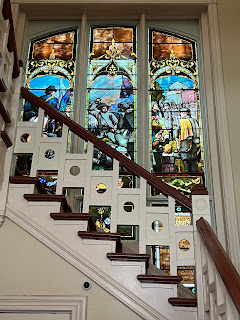
I wouldn't say he exactly delivered on the intended subject. He gave us a lot of history of the building we were meeting in, and laudatory statements about James Meredith, the first African-American student admitted to Ole Miss (he left out the part we learned later at a museum, that the university turned Meredith away four times - including having the governor himself show up to tell Meredith he wasn't welcome there - before letting him in). Mullins had that elliptical Southern way of story-telling, where every time you'd think he was about to get to the point he'd go off into some tangential folksy anecdote (Gail Goldberg had been like this too) and so he talked for a long time but never really quite got around to saying much about recontextualization, even when we went to see the spot where a big statue of Robert E. Lee had stood. He also noted that they hadn't removed everything related to the Confederacy; for example, the admin building is still graced by lovely stained glass windows honoring the "university greys" - Ole Miss students who fought for the Confederacy, and who he felt deserved to be honored for bravely fighting for a cause they believed in. 
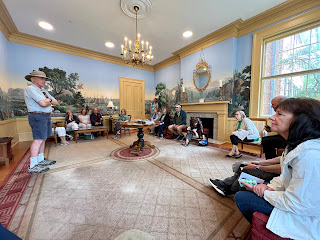
Dr. Mullins tells us more than we needed to know about the history of the building


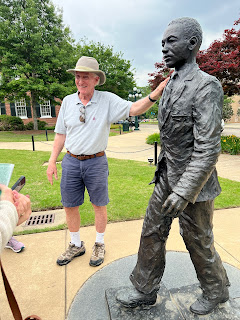
Andy Mullins with a statue of James Meredith

Honoring the "university greys"


Find the spelling mistake if you can!

We stayed overnight at a hotel right across from the campus, located on the historic square at Oxford - a cute college town. We browsed the historic Square Books bookstore and the other shops around the square. I had had an upset stomach for a couple of days, and so for dinner I went off on my own and found a place where I could get a plain grilled chicken sandwich. I had hoped to find some kind of crunchy granola vegetarian kind of restaurant where I could get something light to eat, but apparently things are different in Mississippi - while pretty much every college town I've ever visited has such a hippie tofu restaurant, such a thing doesn't exist at Ole Miss. The chicken sandwich was fine and I was recovered the next day.

Day 7 (Thursday - Memphis, TN):

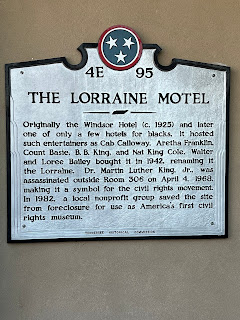
On our last day we climbed on the bus for a drive to Memphis. Yes, I was spending my precious vacation time in Tennessee, of all places. Our first stop in Memphis was the National Civil Rights Museum, which is cleverly built to encompass the Lorraine Motel, where Rev. Dr. Martin Luther King, Jr. was assassinated. Where the Mississippi Civil Rights Museum had been more of a history museum, the National Museum told the story of a movement, to "share the culture and lessons from the American Civil Rights Movement and explore how this significant era continues to shape equality and freedom globally" - from the awful backstory of slavery and post-Reconstruction Jim Crow, through Brown vs. The Board of Education, the Montgomery bus boycott, student sit-ins, Freedom Riders, the March on Washington, Selma, Emmett Till, etc., through to the current day. One comes away with an appreciation of the courage and commitment it took to challenge, and ultimately change, American laws and culture.  

As an aside, I'll note that even without the MLK connection, the Lorraine Motel would itself have been noteworthy. A "Green Book" hotel, it hosted scores of African-American performers who came to record in Memphis.
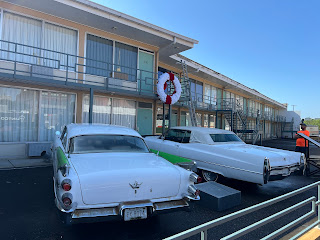
The Lorraine Motel - the wreath marks where Martin Luther King, Jr. was standing when he was shot


Read about the Lorraine Motel yourself

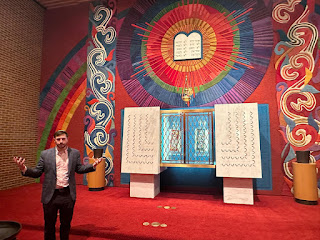
Our last stop was at Temple Israel. Now, we belong to the largest Jewish congregation in Virginia, located in one of the wealthiest counties in the U.S., and so we're used to large, affluent shoooo-uhls, but nothing prepared us for Temple Israel, practically a mega-church among synagogues. We entered an enormous building where our agenda started with lunch with the congregation's clergy, which consisted of tasty barbeque (chicken and beef - no pork) from a restaurant owned by a congregant, with plenty of fixin's - coleslaw, salad, and southern banana pudding (complete with vanilla wafers). By another coincidence, Temple Israel's senior rabbi had been a seminary classmate of our senior rabbi, and their junior rabbi was likewise a classmate of Rabbi Stein, so we had a connection from the get-go. Like Beth Israel in Jackson, Temple Israel has its own historic civil rights figure in the person of Rabbi James Wax. Wax's civil rights activism, as in Nussbaum's case, put him somewhat at odds with his congregation. When Martin Luther King was assassinated, Wax issued a rebuke of Memphis' mayor and, as the leader (and only Jewish clergy!) of the Memphis Ministers' Association, led the MMA's participation in the protest march that followed. Per Memphis magazine's web site, "The rabbi’s rebuke ... got national coverage. He got 81 letters of support, and 121 letters of condemnation. There were countless hostile phone calls and a loss of friends. Some members of the congregation talked of removing him from the pulpit, but the temple’s board of trustees refused to consider such an action — although other ministers who had participated in the march did lose their jobs."

Oh, and I mentioned how enormous this place was. The building contains a gigantic main sanctuary, a more "intimate" chapel which seats several hundred (and is amazingly 70's groovy in design), a museum, a sizable Judaica shop, and seemingly endless grand gathering spaces, classrooms, and more. Plus, in contrast to the age and decay which seeped in around the edges of even the thriving congregations we had visited, Temple Israel was totally up-to-date and spotless. Nonetheless, they talked about how they were about to embark on a big renovation  of some the building's spaces. Apparently they benefit from being the only congregation in the region: west to Little Rock, south to Jackson, east to Nashville or Huntsville, and north to I don't know where - maybe St. Louis. Many congregants belong even though they're too far away to attend services regularly in person. They stream weekly services and attend in person only on holidays. Plus the synagogue benefits from being in the thriving city Memphis, a major transportation and shipping hub (FedEx is headquartered there) - and I would guess from some well-heeled donors. Their congregation isn't growing, but membership is close enough to steady that they feel like they can sustain things for a long time to come. We were left pretty breathless by the vitality and scale of this place.  
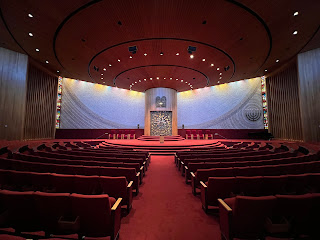
The main sanctuary at Temple Israel

Groovy chapel


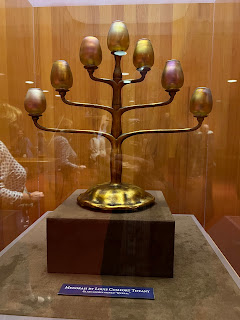
Antique Tiffany menorah

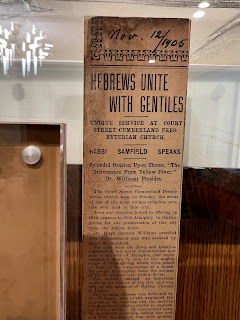
From the museum

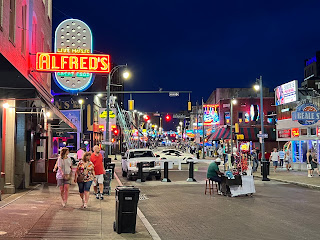
We had hoped to have a little free time in Memphis - to see the Stax Record Museum, or maybe visit Graceland, but alas, by the time we left Temple Israel, we didn't have much free time. We met up again for a farewell dinner, then we were Walking in Memphis, strolling down Beale Street, and poking our heads into the Peabody Hotel.
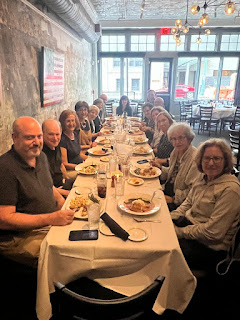
Farewell dinner

Beale Street

Friday morning another traveler and I who had reservations on the same early morning flight, caught a 5:30 AM Uber to the airport. And so ended our visit to the deep south, with a return home to the ... um, shallow south?


Sunday, May 19, 2024

The Mississippi Delta Trip - Part II

Go back to Part I

Day 4 (Monday - New Orleans to Natchez):

Monday morning I wolfed down a quick breakfast so that I could be on the bus in time for our 8 AM departure for Whitney Plantation. In New Orleans we had been getting around by summoning fleets of Ubers; Monday marked the beginning of the chartered bus part of our tour.

Whitney is an old sugar plantation which, admirably, is dedicated to educating the public about the history and legacy of slavery in the south. As bad as it was working cotton, apparently sugar was worse; the life expectancy of slaves was only a few years. That's because while cotton is processed elsewhere once picked, sugar is processed on site, so in addition to field work hacking tough sugar cane, slaves manned a 24 hour processing plant in which the sugar was extracted from the cane and then concentrated down into molasses. That meant long hours stirring huge boiling cauldrons. Terrible, hot,  dangerous work on top of all the other horrors of slavery. Our guide, a very passionate woman who was happy to be leading a group "of her generation", did point out that Louisiana  was unique in that slaves were allowed to earn money in their (minimal) spare time, and if they saved up could buy their freedom. Even though she was eager to present an unvarnished version of plantation life, even she couldn't resist a little whitewashing, as we learned later that the ability of slaves to buy their freedom was pretty much stamped out in practical terms if not in statute.

Sugar kettles 

On the plantation tour

Children's Memorial at the Plantation

The plantation house. Interestingly, it was only one room deep - for ventilation in the sticky climate

Slave quarters

After the sobering plantation tour we got back on the bus, headed to Natchez. I wish I had kept my phone out to take pictures of some of the businesses we passed, like "Praise the Lard" pork shop. We ate lunch on the bus. The food, from Mulberry Market in Baton Rouge, was surprisingly good. Who would have expected decent bagels and lox in Baton Rouge, Louisiana?!

Yes, bagels and lox in the Mississippi Delta!

In Natchez we visited Temple B'nai Israel. There's no active congregation there anymore, but the building is preserved by the city and the Institute for Southern Jewish Life. Clearly it was built by a well-heeled congregation (cotton trading money), and apparently it was always oversized - sized aspirationally for a large Jewish community which never came to pass. Instead, after peaking in the 1950's, the Jewish community slowly dribbled away - the next generation moved away to larger cities, and the community and its historic businesses pretty much died out. As one of our guides said, "the Jewish history in the South is of fathers building businesses for sons who didn't want them." Hearing that as a son who didn't go into a family business which had been built over two generations, that quip smarted! Anyway, I imagine there are lots of buildings like this across the South and small-town America in general. This one is being preserved - but not all have such a lucky fate. 

B'nai Israel had a lovely pipe organ - not atypical in "classical" Reform Judaism, which modeled aspects of its religious practice after Christian church services (my childhood synagogue had an organ, as, at the time I joined, did the synagogue I belong to in Virginia). As I may have mentioned in Part I, the Jews of the South were largely German/Alsatian immigrants, less traditionally religiously observant than the Eastern European Jews who came later, and more likely to affiliate with the more assimilated Reform variant of Judaism, hence the organ and choir. Another quip: "there were Jews in the South, but not necessarily Judaism." Unfortunately, no one was around to power the organ up, so I just posed with it for pictures.

Wish I could have played this baby!

Temple B'nai Israel: Exterior
That organ again


B'nai Israel: Interior

We also visited the historic Jewish cemetery, which includes the grave of seven year old Rosalie Beekman, the only Natchez resident to die in the Union attack on the town in 1862.

We stayed overnight in downtown Natchez, which is a small city witht a lovely setting alongside the river. We went out for a walk to see what we could find in terms of food. A lot of the group chose a tamales restaurant, and others chose BBQ. That left just three of us who didn't want a meat-heavy dinner: Rabbi Stein (a vegetarian), a fellow congregant Rebecca, and I. The three of us ate at a surprisingly upscale Italian restaurant, where I had a very nice salad and flatbread pizza. Overnight was at the Hampton Inn - which was a step up from the Hampton Inn I stayed at in Vicksburg long ago in that there wasn't an armed guard in the lobby.

I will add that my fellow traveler Rebecca is originally from Texas and so Southern Jewry wasn't as much of a surprise to her as it was to some of the rest of us. Also, she was certain that her Galveston relatives must know my brother's wife's family, since there aren't many degrees of separation between most Galveston Islanders. We each texted our relatives. Indeed, they did know each other.

Day 5 (Tuesday - Natchez to Jackson, MS):

Another early morning departure. Our first stop was the Mississippi Civil Rights Museum, which is pretty up-front about the state's nasty history of racism, including violence directed against civil rights activists. The peak of the civil rights movement was during my toddlerhood, so I've just got a fuzzy, jumbled history in my head. There was a lot of focus at the museum on, for example, the Freedom Riders - integrated groups of activists who rode Greyhound and Trailways buses into the South to test the United States Supreme Court decision banning segregation in public interstate transportation. Needless to say, in Mississippi Freedom Riders were arrested, and in some cases jailed. Buses were bombed, people were beaten - it wasn't pretty. 

Mississippi racial history isn't pretty


Shame on you, Mr. Friedman, for contributing to this song

We also visited the home of civil right leader Medgar Evers, who was assassinated in his driveway by a member of the White Citizens' Council, a segregationist/racist group. Evers was enough of a target that he usually had police protection - strangely absent the day of his killing - some say the cops were Klan and were in on it. The house has been preserved; you can still see where a bullet from the high powered hunting rifle used by the assassin went through the front of the house, traveled through the living room and another wall into the kitchen, and dented the refrigerator. Evers was taken to a local hospital where he was initially refused admission because the hospital was whites-only. He died at the hospital, having under tragic circumstances achieved the milestone of being the first black person to be treated there.

Medgar Evers' house

Bullet hole by the toaster. Evers' wife and young children were at home at the time of his assassination

We also visited Beth Israel Congregation in Jackson, which was founded in 1860. Unlike the synagogue we visited in Natchez, Beth Israel is an active congregation. Their rabbi had interned at our congregation while he was in rabbinical school; in fact, the congregant with whom he had stayed during his internship was part of our group, so he was happy to see us. 

The congregation's rabbi during the 1960's, Perry Nussbaum, was a Yankee transplant and a strong advocate for civil rights, which put him a little out of step with his congregants, not all of whom were on board with this whole black/white equality thing. Both the synagogue and Nussbaum's home were bombed by the Ku Klux Klan, but apparently he was undeterred. At Beth Israel Rabbi Nussbaum was spoken of with great veneration. It was interesting after the trip to read up on him in Wikipedia. Apparently, while he was indeed a fearless advocate for civil rights, he was also a headstrong, sometimes abrasive character, who was shocked to find how assimilated his congregants were and chided them for having Christmas trees in their homes, and he complained they had no interest in Hebrew, Zionism, or much in the way of traditional religious practice. Welcome to Mississippi, Rabbi Nussbaum!

I will say that after Beth Israel was bombed, the Greater Jackson Clergy Alliance, which Nussbaum had founded, marched in support of the synagogue. The group of 60 clergy representing 10 faiths was the first interfaith event ever to take place in Jackson!

At lunch Rabbi Stein were again the odd people out, choosing a ramen restaurant where we could get vegetarian food (the ramen was much better than one would expect in Jackson, MS - and was delivered by a robot!). The group ate dinner together at Jackson institution Hal and Mal's. The vibe of the place was a little hard to figure out - TGIFriday's kind of decor, but a more upscale menu, and a live jazz trio. I had a tasty redfish platter ("redfish" is a southern thing - but I think it's really the same fish as either what we call drum or some species of snapper).

The next day we were headed to Greenwood Mississippi.


Ramen delivery robot

Thursday, May 16, 2024

The Mississippi Delta Trip - Part I

 Here are my takeaways from the Jewish History of the Mississippi Delta trip I just participated in: 

(1) People are awful

(2) People are amazingly resilient

(3) People are occasionally awesome

(4) Music is always good

The primary focus of this trip has been the history of Jews in the American South, particularly in the region known as the Mississippi Delta, but we've also touched on African-American history - slavery and the civil rights movement. So we've had ample opportunity to explore people at their worst and best. Plus, American roots music has never been far from our minds as we've traveled from New Orleans through the region known as "the birthplace of the blues", to Memphis.

This was a week-long trip organized by my synagogue and I'm not going to write a blow-by-blow account of every day, but I will document some highlights.

Day 1 (Friday - New Orleans): Our trip started in New Orleans during the second weekend of Jazzfest. The Rolling Stones had just played Jazz fest the night before, and the city was full of energy. Our first official stop was the special (sold out!) Jazzfest Shabbat service held Friday night at Touro Synagogue. We arrived without reservations, but our rabbi exchanged some rabbinic gang signs with Touro's clergy, and somehow they let us in. It was a lot of fun. I'd like to say it was super-amazing, but I've seen enough Jewish-other cultural mashups before (remember, I had hosted a Grateful Dead Passover Seder just a few weeks prior) that it wasn't totally novel. But New Orleans has tons of great musicians, so came as no surprise that the bands were great. A fun way to start off the the trip.

Jazzfest Shabbat Service at Touro Synagogue

Day 2 (Saturday - New Orleans): There's a gag in the movie Airplane where a passenger asks the flight attendant for some light reading material (Airplane was made way back when airlines provided magazines for passengers to read) and the flight attendant responds with "How about this leaflet about famous Jewish sports legends?" I think of that joke whenever I hear the name "Museum of Southern Jewish History" because, really, how much could there be to a museum on this topic? But it turns out there's more than expected. Many Americans (well, at least those of us from the cities of the Northeast) think of the normative Jewish immigrant experience as starting with a densely Jewish ghetto like the Lower East Side of Manhattan (we had a Jewish history professor from Emory University traveling with us, so I can use words like "normative"), but in fact, plenty of Jews, particularly from the early Sephardic and German/Alsatian mid-19th century wave of immigration, went where business opportunities were good, including into the cities and towns of the deep South. Jews in these communities were typically merchants, either itinerant peddlers or shopkeepers. Waves of Jewish immigrants arrived as the South was expanding, and as with many immigrant groups, they were given a typically American "you're not really our kind of people, but you're useful, so come on in!" kind of welcome. Many Jews prospered, some even became wealthy, and in the antebellum era some even raised their social status by becoming enslavers just like their Christian neighbors (yuck). So the Jewish history of the South goes back a ways; many of the congregations visited are over 100 years old. There may never have been a lot of Jews in any of these places, but it seems like every town had a little bit Jewish history, stretching back to the 19th century if not earlier.

Jewish history hiding in plain sight in Mississippi

All that is preface for saying that we started Saturday with a trip to the Museum of Southern Jewish History. I'd been there before, but it was still interesting to visit. Our professor/guide dude also led us on a Jewish history walking tour of the French Quarter, thanks to which I can now say that I tried to go with a rabbi to visit a strip club on Bourbon Street. Actually, we were looking for the former home of Judah Benjamin, U.S. Senator and Confederacy Cabinet officer and found the building occupied by the aforementioned strip club, which, BTW was closed for renovations. There's lots of other Jewish history in New Orleans, if you know where to look. For example, why does the building containing the Ritz-Carlton on Canal Street have ornaments with the initials "MB"? Because the 1906 building was built to house the Maison Blanche, a Jewish-owned department store.

The group also met with the leader of Jewish Pride of New Orleans (JPNOLA) to hear about Jewish LGBTQ life in New Orleans (very open and vibrant LGBTQ community, as you might expect). Given that he and friends he had invited to participate were all Tulane or Loyola professors, our conversation also touched on the campus protests going on over the war in Gaza. Our meeting was held at a phenomenal 1840's house on Esplanade Ave. Not the JPNOLA guy's home - he was pet-sitting there for a friend. The visit would have been worth it for the house alone.

The head of JPNOLA, his two friends (they're a married couple, hence the matching outfits), and the dog he was pet sitting

Quite the house

Dinner that night was simply spectacular - a feast at Saba, an Israeli restaurant in the Garden District. In a city where it seems every dish contains pork or shellfish (two things I don't eat for religious reasons), it was wonderful to eat in a restaurant where none of that treyf stuff was on the menu. But even people without such dietary constraints found a lot to love on Saba's menu. Over dinner we met with L J Goldstein, founder of the Krewe of Jieux, the first Jewish Mardi Gras Krewe. While influential Jewish merchants were involved in the formation of some of the earliest modern Mardi Gras parades, Jews were historically excluded from participating. While I'm sure Jews had participated on the sly over the years, in the 1990's Goldstein decided to break down that historic barrier by creating an explicitly Jewish "krewe". The krewe defangs anti-Semitic stereotypes by really leaning into them to the point of ridiculousness. While other floats toss beads, the Krewe of Jieuxs tosses gold bagels. While other krewes have a king and queen, his has a King of the Jews and Jewish American Princess. Other krewes have a "Witch Doctor"; the Krewe of Jieuxs instead has a "Rich Doctor". Everyone in the parade wears horns. You get the idea. Goldstein is a character, but he is genuinely motivated to offer unaffiliated Jews a pathway to connecting to Judaism through his event, and he's also pushing back against the ingrained anti-Semitism of traditionally Catholic Louisiana. One example of that historic bias - the laws of slavery in Louisiana were codified in what was called the Code Noir (Black Code), dating to 1685 when Louisiana was still a French colony. The code contains fifty-nine Articles, fifty-eight of which have to do with slavery. But before they get to those fifty-eight, guess what Article I does? I mean, what was so important that they had to put it right up front ahead of the main content? That's right - Article I expels all Jews!

Anyway, check out a New Orleans brass band playing klezmer music at the 2017 Krewe of Jieuxs 2017 parade here, and read more here

Nighttime entertainment

Let me interject at this point that I was the youngest congregant in our rather superannuated tour group, and also that I was sharing a room with a guy I really didn't know that well. After dinner while everyone else went home (to bed, no doubt), I went out to see "George Porter, Jr. and a Tribute to New Orleans Funk" at the Joy Theater, just steps from our hotel. Jazzfest weekend you can go out and see late night shows all the way through until the next morning, but out of respect for my room mate Alex I didn't stay out very late. The show I went to was supposed to start at 9, but didn't get underway until 10:30 (unconscionable, IMHO) and I bailed before it got too late.

Day 3 (Sunday - New Orleans):  While on Saturday I just ran down to the local Starbucks for breakfast (the only place open at 6 AM), Sunday I joined the group at a diner next to the hotel. This wasn't an organized group meal - people from the group just kept dribbling in. This caused a great deal of consternation to the hostess, who really wanted to spread people around the different server sections of the restaurant, but people from our group kept ignoring her and joining the existing table. Fortunately I was one of the first in and first out, so I was able to stay clear of the somewhat heated clash between the increasingly pissed off hostess and the cranky old Jews of our group.

Anyway, Sunday morning we visited a few more synagogues, including the thriving Reform Temple Sinai and the decrepit, holding on by a thread Orthodox Anshe Sfard. Our synagogue tour was led by local Jewish historian Irwin Lachoff, who told us the heartbreaking story of how his dad passed away during the days immediately following Hurricane Katrina, and how not only couldn't he make it there to see his dad (because of travel restrictions), but of the trouble he had even giving him a proper burial because everything was disrupted by the hurricane.

Temple Israel

Temple Anshe Sfard

Southern Jewish Literature*

*I posted this picture on Facebook, to which my friend Jen commented "My friend’s grandma wrote this!"

From lunchtime on we had free time. I sought out a vegan po' boy sandwich at the French Market, where by chance I sat with a couple who it turned out were among the organizing committee for the original Bay Area Grateful Dead Passover Seder - weird coincidence! Then I hoped a bikeshare bike and pedaled over to the Garden District, where I rode through the streets looking at the stunning historic homes. Let me tell you - New Orleans has the worst paved streets. I risked internal organ damage riding a bike there.

Biking the Garden District

Window shopping

After dinner (good Vietnamese chicken phở!) on Magazine St., I hopped back on a bikeshare bike and rode up to mid-City where I caught the Stanton Moore Trio at The Broadside. While the New Orleans Funk show the night before had been just OK, both the brass band which opened and Stanton Moore were phenomenal. Plus, it was Sunday night - a lot of Jazzfest attendees had headed home - and this show was outdoors and so was totally uncrowded and mellow. Plus, the couple I met at the French Market were there (not a surprise - we had discussed our evening plans when we had met earlier), so I had someone to hang out with.

Outdoor stage at The Broadside

That's the end of the New Orleans part of this adventure - Monday morning we hit the road, headed for Mississippi.

Continue to Part II


Sunday, April 28, 2024

Grateful Dead seder

What do the Grateful Dead and the Jewish ritual of a Passover seder have in common? Nothing. Except maybe that Dead shows and Passover seders seem to go on for a really long time. Also, maybe that they both feature leaders with big beards. And they both feature some kind of burning bush ... if you get my drift.

Anyway, Phil Lesh, the Dead's bass player, for a while owned a music venue in San Rafael, CA called called Terrapin Crossroads. In 2014 Ross James, a (Jewish) musician in Phil's orbit, asked Phil if they could host a Passover seder at his venue, and Phil not only concurred, he participated. The event was such a hit that they held it every year until the start of the pandemic. They even created their own Haggadah (the book is read at the seder, containing the Passover story and related explanations, along with prayers), which was surprisingly straight and unhippyish, except for the illustrations, commentary in the form of word bubbles from a little Grateful Dead terrapin dude (see the cover of the Terrapin Station album - the "terrapin" is a recurring Dead symbol), and the almost complete absence of mention of God.

The local Jewish community in DC has a disproportionate number of Jews (others have noted that this seems to be true as well throughout the Deadhead community). Many of my Jewish Deadhead friends seem much more connected to the band than to their religion (one friend having gone so far as to tell me that "The Grateful Dead is my religion"), and so I decided to create a Grateful Dead-themed Passover seder to help make this Jewish holiday more accessible to the Jewish Deadhead community. For two years I held the event at my house, which limited the number of people who I could invite. This year we went big and rented the Glen Echo community room - and got so many attendees that even with the larger capacity we wound up having to turn people away!

The gang

So, what was the seder like? I started with Lesh's Terrapin Haggadah, but trimmed it down a bit, including eliminating the whole part which would normally come after the meal (I was sure there was no way I was going to get the group to sit down for more ritual after they got to eating and schmoozing). I then sprinkled in a bunch of songs. A couple were seder text set to Grateful Dead songs, (for example, the Four Questions set to the tune of the song Ripple). Most were parody songs - clever (I hope) Passover-related lyrics for Dead and other classic rock songs. I drew on my friend Barb's Passover song parodies web site for "Hey Jews" (Hey Jude) and "Are You Ready for Passover Fare" (Scarborough Faire), grabbed Larry H's "It Must Have Been Charoses" (the Dead's It Must Have Been the Roses), plus a few of my own (like "Pharoah's Palace" for the Dead's Brokedown Palace). Valerie joined me up front, helping to keep order (she has that schoolteacher voice that people just obey) as well as adding her own brand of wackiness. Food was potluck and plentiful, and didn't even have to be kosher for Passover since the event was the night before the start of the holiday!

Leading the mayhem

I don't want to brag, but it drew comments like, "... the best seder I have ever experienced", "... so beautifully moving", and "What a special, meaningful, lively, loving, grateful, delicious seder!" So yeah, I think it was a success. We're already looking for a bigger room for next year.

And of course, I could not have made this event work without my fellow planners, Wendy (who wrangled all the attendee aspects including coordinating the pot luck), and Karen (who handled the logistics of the room, supplies, and decorating), as well as the volunteering of Woody, Jon, Carol, and so many more!

We had the ritual seder plate at every table

My Grateful Dead Haggadah

View from the "pulpit"


The organizers

PoG Staggers to Life

 My great-grandfather was said to have a particular knack for getting into and out of businesses at the wrong time. For example, shortly aft...